

Navigating the U.S. immigration process can be particularly crucial for entrepreneurs who are not just chasing the American Dream but also bringing valuable innovation and job opportunities to the U.S. economy. Understanding the intricacies of this process is vital for those looking to establish or expand their businesses in the United States. The right visa can serve as the key to unlocking immense potential for business growth and personal development within the bustling market of the U.S.
Entrepreneurs and skilled workers have several immigration pathways tailored to their unique skills and business objectives. These range from temporary work visas to permanent residency options, each designed to facilitate the contributions of innovative minds to the U.S. economy. Familiarity with these options can greatly enhance an entrepreneur’s chances of successfully navigating the complex landscape of U.S. immigration law and policy.
Understanding Visa Categories
H-1B Visa for Specialized Occupations
The H-1B visa is a popular choice among tech companies and other industries that require specialized knowledge. This visa category allows U.S. employers to temporarily employ foreign workers in specialty occupations. The key requirements include having a higher education degree or its equivalent. The H-1B is particularly advantageous for those in the STEM fields, offering a way to bring specialized skills that might be scarce in the U.S. workforce.
L-1 Visa for Intracompany Transfers
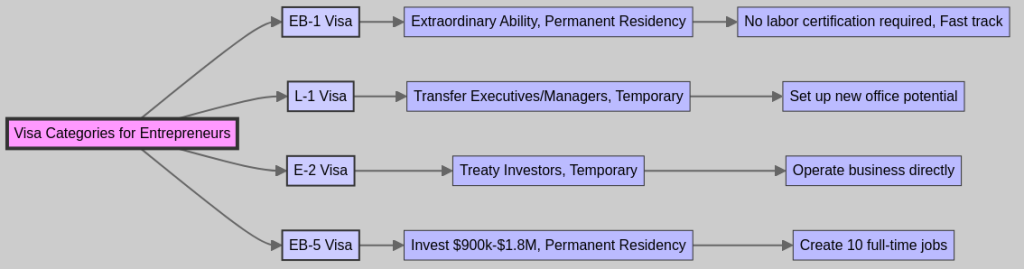
For entrepreneurs who already have a business and are looking to expand operations into the U.S., the L-1 visa provides a great opportunity. This visa facilitates the transfer of a foreign worker in an executive, managerial, or specialized knowledge position to a U.S. branch of the same company. This is ideal for those who are looking to establish a new office in the U.S. or need to move key employees to manage existing operations.
E-2 Treaty Investor Visa
The E-2 visa is tailor-made for investors and entrepreneurs from countries that have a Treaty of Commerce and Navigation with the U.S. To qualify, you must invest a substantial amount of capital in a U.S. business and plan to develop and direct the operations of this business. The E-2 visa is highly attractive because it allows an entrepreneur to work legally in the U.S. for the company they are developing, facilitating active involvement in the growth and management of the business.
Green Card Options for Entrepreneurs
Pathways to Permanent Residency Through Investment and Employment
For entrepreneurs eyeing a more permanent stake in the U.S. market, obtaining a Green Card might be the ultimate goal. There are several pathways through which business innovators can secure permanent residency, notably through the EB-5, EB-1, EB-2, and EB-3 visa categories. Each of these has specific requirements and benefits tailored to the unique capabilities and roles of the applicants.
EB-5 Immigrant Investor Program
The EB-5 visa program is specifically designed for investors. To qualify, entrepreneurs must invest either $900,000 in a targeted employment area (TEA) or $1.8 million in a non-TEA, creating at least 10 full-time jobs for U.S. workers. This path not only leads to permanent residency but also allows the investors to bring their spouse and unmarried children under the age of 21 to the U.S. .
EB-1 Visa for Individuals with Extraordinary Ability
The EB-1 category is reserved for individuals who possess extraordinary ability in their field (e.g., sciences, arts, education, business, or athletics), demonstrated by national or international acclaim. Entrepreneurs who can prove that their abilities are exceptional may qualify under this category, which typically does not require labor certification, speeding up the process .
EB-2 Visa for Professionals Holding Advanced Degrees
For entrepreneurs with advanced degrees or exceptional ability in the arts, sciences, or business, the EB-2 visa can be an appealing option. This category often requires a job offer from a U.S. company and a labor certification that proves no suitable U.S. worker was available for the position. However, a National Interest Waiver can be obtained which allows entrepreneurs to bypass the labor certification if their business endeavor is deemed beneficial to the U.S. national interest .
EB-3 Visa for Skilled, Professional, or Other Workers
The EB-3 category covers skilled workers (requiring at least two years of training or experience), professionals (requiring a U.S. bachelor’s degree or foreign equivalent), and other workers (for unskilled labor that requires less than two years of training or experience). This visa also requires a job offer and labor certification .
Navigating the Application Process
Step-by-Step Application Procedures
The process of applying for a Green Card can vary significantly based on where you are applying from and the category under which you are applying.
- Determine Eligibility: First, identify under which category you can apply, whether EB-1, EB-2, EB-3, or EB-5, as the eligibility requirements differ for each.
- Petition Filing: For most employment-based applications, including EB-1, EB-2, and EB-3, this involves filing Form I-140 (Immigrant Petition for Alien Worker). For the EB-5 category, you would file Form I-526 (Immigrant Petition by Alien Entrepreneur).
- Adjustment of Status or Consular Processing: If you are already in the U.S., you may file Form I-485 (Application to Register Permanent Residence or Adjust Status). If outside the U.S., you will go through consular processing at a U.S. embassy or consulate.
- Labor Certification: For some categories, especially EB-2 and EB-3, obtaining a labor certification from the Department of Labor is necessary before filing the petition. This step ensures that hiring a foreign worker will not adversely affect U.S. workers .
- Attend Interviews and Provide Documentation: Depending on your application pathway, you may need to attend an interview and provide additional documentation, such as proof of investment for EB-5, or evidence of extraordinary ability for EB-1.
- Final Approval and Green Card Issuance: After all forms are submitted and fees are paid, USCIS will process your application. Approval times can vary, but once approved, you and your eligible family members will receive your Green Cards.
This structured approach can help simplify the complex web of requirements and procedures, making the U.S. immigration process more accessible for entrepreneurs committed to contributing to the U.S. economy.
Financial Considerations
Understanding the Costs
Embarking on the U.S. immigration journey involves various costs that can significantly impact your financial planning. These costs vary depending on the immigration pathway—be it through employment, investment, or family-based visas. The application fees alone can range from a few hundred to several thousand dollars. For instance, the EB-5 investment visa requires a substantial financial commitment that includes a minimum investment of $900,000 in targeted employment areas or $1.8 million in other areas, plus associated legal and administrative fees.
Budgeting for Immigration
It’s crucial to budget not only for the direct costs associated with filing U.S. government forms but also for potential legal expenses. Hiring a competent immigration attorney can help navigate the complex legal landscape, which, although an additional cost, can save money in the long run by avoiding costly mistakes and delays. For detailed and up-to-date information on government filing fees, the USCIS website provides a comprehensive fee schedule that applicants should consult regularly.
Legal and Regulatory Considerations
Navigating Legal Hurdles
The U.S. immigration system imposes various legal hurdles, including dealing with issues of inadmissibility which might be due to health, financial status, or criminal history. Understanding these challenges is crucial, as they can potentially bar entry into the U.S. or impact one’s ability to secure permanent residency or citizenship.
The Role of Legal Counsel
Given the complexities and frequent changes in immigration law, securing knowledgeable legal counsel is advisable. An attorney specialized in immigration law can provide invaluable guidance through the application process, help address any issues of inadmissibility, and ensure compliance with all legal requirements. This support is especially crucial when applying under more complex categories like the EB-5 or when dealing with potential inadmissibility issues.
In Conclusion
Understanding the U.S. immigration process is more than a bureaucratic necessity; it’s a strategic step towards achieving business success and sustainability in the U.S. market. From choosing the right visa category to budgeting for associated costs and navigating legal hurdles, each phase of the immigration process requires careful planning and informed decision-making. For entrepreneurs, mastering this process can unlock immense opportunities, allowing them to bring their innovative ideas and entrepreneurial spirit to one of the world’s largest markets. With the right preparation and guidance, the complex web of U.S. immigration can be navigated successfully, setting the stage for long-term business growth and success.