

In the diverse tapestry of U.S. immigration, the O-1 visa stands out as a unique pathway designed for individuals of extraordinary ability. This visa category is pivotal in the U.S. immigration landscape, not just as a means of entry but as a beacon attracting global talents to the United States. The O-1 visa is instrumental in bringing together the brightest minds from across the globe, offering them a platform to excel and contribute significantly in their respective fields, thereby enriching the U.S.’s cultural and professional landscape.
Decoding the O-1 Visa: Eligibility and Types
Exploring the O-1 Visa Categories
The O-1 visa is segmented into two distinct categories: O-1A and O-1B. The O-1A visa caters to individuals with an extraordinary ability in the sciences, education, business, or athletics, while the O-1B is tailored for those with exceptional achievements in the arts, motion picture, or television industry. This bifurcation ensures that the visa addresses the specific nuances and requirements of varied professional realms.
Eligibility Criteria: Demonstrating Extraordinary Ability
Eligibility for the O-1 visa hinges on demonstrating extraordinary ability. For O-1A, this might include evidence of a major, internationally-recognized award, or other significant achievements in their field. The O-1B category requires proof of distinction such as notable performances, critical roles in distinguished organizations, or significant recognition from experts in the field. The criteria are stringent, aiming to ensure that only those at the pinnacle of their professions are granted this prestigious status.
Preparing a Winning O-1 Visa Application
Crafting a Compelling Application
The journey to a successful O-1 visa application begins with a meticulous compilation of evidence and documentation. The application must weave a compelling narrative, showcasing the applicant’s extraordinary abilities and achievements. It involves collecting letters from experts, awards, publications, and other relevant evidence that collectively argue the case for the applicant’s extraordinary status.
Strategic Tips for Application Success
Key to a winning application is tailoring the evidence to meet the O-1 visa’s specific criteria. This may involve highlighting notable accomplishments, such as leading significant projects, receiving prestigious awards, or making critical contributions to the field. It’s crucial to align the documentation with the visa’s stringent standards, ensuring that each piece of evidence clearly demonstrates the applicant’s extraordinary ability and standing in their profession.
Common Hurdles in the O-1 Visa Process
1. Proving Extraordinary Ability
One of the most daunting aspects of the O-1 visa application is the need to demonstrate extraordinary ability. Applicants must provide substantial and convincing evidence, such as national or international awards, membership in associations that require outstanding achievements, or significant contributions to their field.
2. Role of Peer Advisory Opinions
The application often requires a peer advisory opinion, or a consultation, from a relevant peer group or a labor organization. Understanding how to procure and effectively utilize these opinions is vital, as they provide an expert perspective on the applicant’s achievements and standing in their profession.
3. Demonstrating Sustained Acclaim and Recognition
Applicants must also prove that they have sustained national or international acclaim. This can be challenging as it involves not only past achievements but also an ongoing recognition of excellence in their field.
4. Navigating Legal Challenges
The legal intricacies of the O-1 visa process can present significant hurdles. These might include accurately interpreting visa regulations, adhering to stringent documentation requirements, and addressing any legal issues that might arise during the application process.
U.S. Visa Trends for Exceptional Talents (1997-2015)
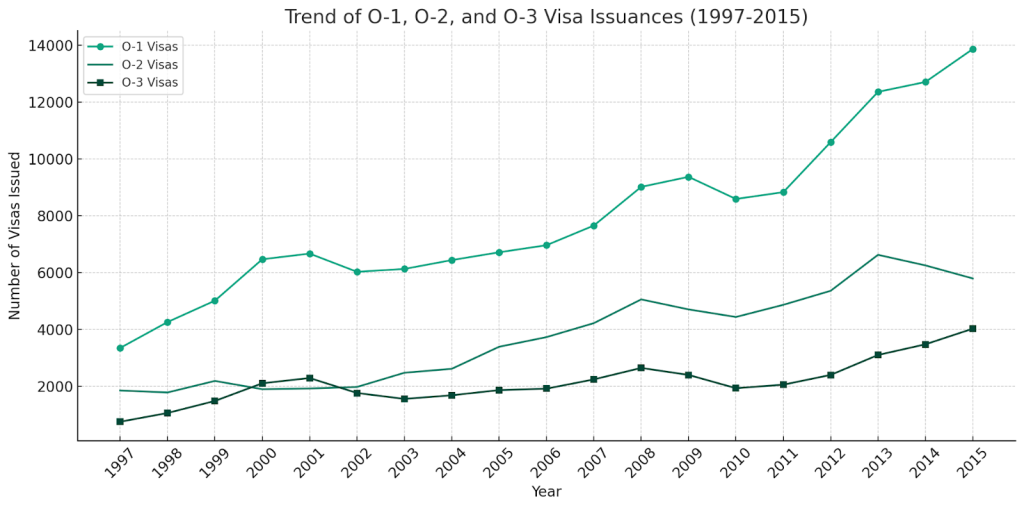
The graph presents a comprehensive view of the issuance trends for O-1, O-2, and O-3 visas from 1997 to 2015. It depicts a clear upward trajectory in the issuance of these visas, indicative of the increasing demand for exceptional talent in the United States.
O-1 Visas: This category, for individuals with extraordinary abilities, shows a significant and steady increase. Starting from 3,345 visas in 1997, the number grew to 13,865 by 2015, reflecting the U.S.’s commitment to attracting top global talents in various fields.
O-2 Visas: These visas, for individuals accompanying O-1 visa holders, also show a rising trend, though with some fluctuations. The number increased from 1,848 in 1997 to 5,792 in 2015, suggesting a parallel growth in the support personnel for extraordinary ability visa holders.
O-3 Visas: Issued to dependents of O-1 and O-2 visa holders, these visas too saw a growth, indicating an increase in the number of families accompanying the primary visa holders. Starting from 748 in 1997, the issuances rose to 4,023 by 2015.
Overall, the graph highlights the growing allure of the United States as a destination for extraordinary talents worldwide, with increasing numbers of these talents and their families and associates seeking opportunities in the country over the years.
The Future of Talent Mobility and O-1 Visas
Evolving Role of O-1 Visas in Global Talent
Experts in immigration law and global talent acquisition discuss the evolving role of the O-1 visa in today’s fast-paced, highly competitive global talent landscape. They emphasize that the O-1 visa has become a crucial tool for attracting top talent to the United States, enabling it to maintain a competitive edge in various industries.
Impact of Changing Immigration Policies
The potential impact of changing immigration policies on the O-1 visa program is a hot topic among these experts. They delve into how shifts in political climate and immigration reform can reshape the criteria, process, and accessibility of the O-1 visa, affecting talent mobility worldwide.
O-1 Visa: A Catalyst for Innovation and Exchange
The importance of the O-1 visa in fostering innovation and cultural exchange is highlighted as a key factor in its ongoing relevance. By allowing individuals with extraordinary abilities to work and collaborate in the U.S., the visa not only contributes to the professional growth of these individuals but also enhances the cultural and intellectual richness of American society.
Navigating the O-1 visa process involves overcoming a series of complex hurdles, but its importance in the global talent arena remains undisputed. As the world of international talent and immigration continues to evolve, the O-1 visa stands out as a significant facilitator of innovation, cultural exchange, and professional development.
FAQs on the O-1 Visa Journey
What does the O-1 visa application process entail, and how long does it typically take?
The O-1 visa application process involves preparing and submitting substantial evidence to demonstrate the applicant’s extraordinary ability in their field. While there’s no set timeline for the process, it generally takes several months, depending on the complexity of the case and the current processing times of USCIS. The quality of the application and the strength of the supporting evidence significantly influence the chances of approval.
How can an individual maintain their O-1 visa status?
To maintain O-1 visa status, the individual must continue engaging in the activities for which the visa was issued and comply with all U.S. immigration laws. This includes staying with the employer or agent who petitioned for the O-1 visa and adhering to the terms of their visa.
Are O-1 visa extensions possible, and what are the conditions?
Yes, O-1 visa extensions are possible and are usually granted in one-year increments. To qualify for an extension, the visa holder must demonstrate that they continue to meet the criteria for the O-1 visa and that their presence in the U.S. is required for the same activity or event for which the original visa was granted.
Can the O-1 visa lead to permanent residency in the U.S.?
The O-1 visa can indeed be a pathway to permanent residency in the U.S. Many O-1 visa holders transition to permanent residency through categories like the EB-1 visa, which is for individuals with extraordinary abilities. This transition involves meeting additional criteria and going through a separate application process for permanent residency.
In conclusion
The O-1 visa stands as a testament to the United States’ commitment to attracting and nurturing talents with extraordinary abilities from across the globe. It plays a crucial role in maintaining the country’s status as a hub for innovation and excellence. For those embarking on the O-1 visa path, the journey demands diligence, thorough preparation, and an unwavering commitment to excellence. Yet, the rewards, both professional and personal, are boundless, offering a world of opportunities to contribute to and thrive in the dynamic landscape of the U.S. This visa is not just a pathway to the U.S.; it’s a gateway to realizing one’s highest professional aspirations and making an indelible mark on the global stage.