

In the dynamic world of international business, the L-1 visa emerges as a pivotal tool, unlocking immense opportunities for companies aiming to expand their global footprint. This visa category is specifically designed to facilitate the seamless transfer of foreign employees to the United States, serving as a bridge between global talent and business growth. Its significance in the global business landscape cannot be overstated, as it empowers companies to leverage their international workforce effectively, driving expansion and innovation across borders.
Understanding the L-1 Visa: Types and Criteria
Decoding the L-1 Visa Categories: L-1A and L-1B
The L-1 visa is categorized into two distinct types: the L-1A and L-1B, each serving a specific purpose in international business operations. The L-1A visa is tailored for executives and managers, facilitating their transfer to manage an organization or a major function within a company in the United States. On the other hand, the L-1B visa caters to employees who possess specialized knowledge crucial to the company’s interests, such as proprietary techniques or processes.
Eligibility Requirements for the L-1 Visa
Obtaining an L-1 visa requires meeting specific criteria. The applicant must have been employed by the overseas company for at least one continuous year within the preceding three years before admission to the United States. The company must also have a qualifying relationship with the U.S. business where the employee will be transferred. This relationship can be in the form of a parent company, branch, subsidiary, or affiliate.
Navigating the L-1 Visa Application Process
Embarking on the L-1 Visa Journey
Applying for an L-1 visa involves a series of steps, each crucial for a successful application. Initially, the U.S. employer must file Form I-129, Petition for a Nonimmigrant Worker, with U.S. Citizenship and Immigration Services (USCIS). This form should be accompanied by comprehensive documentation demonstrating the qualifying relationship between the U.S. and foreign companies, the applicant’s eligibility, and the job’s nature in the United States.
Streamlining the Application for Success
To expedite the L-1 visa application process and enhance the chances of approval, several tips can be followed. Ensure that all documentation is thorough, clear, and accurately reflects the business’s operations and the employee’s role. Documentation should include evidence of the employee’s qualifications, the nature of the position in the U.S., and the company’s structure and operations. It’s also advisable to anticipate any potential queries from USCIS and address them proactively in the application.
Top 5 Benefits of the L-1 Visa for Global Businesses
1. Facilitating International Talent Mobility: The L-1 visa streamlines the process of transferring key employees within a company across international borders. This ease of mobility is crucial for companies looking to leverage global talent and expertise in different markets.
Enhancing Global Business Strategy: With the L-1 visa, businesses can enhance their global strategy and expand into new markets more effectively. It allows companies to bring in experienced managers and specialists who understand the company’s operations, ensuring a smoother entry into new markets.
Developing Global Leaders: The L-1 visa fosters leadership development and global management experience. Transferring managers or executives to the U.S. offers them invaluable international exposure and experience, broadening their perspectives and enhancing their leadership skills.
Offering Flexibility and Extended Duration: Compared to other visas, the L-1 provides advantageous flexibility and duration. L-1A visas can be granted for up to seven years, and L-1B for up to five years, allowing for long-term planning and stability in workforce management.
Strengthening Global Competitive Edge: By leveraging the L-1 visa, businesses can strengthen their global presence. Having a team with diverse international experiences and skills gives companies a competitive edge in today’s globalized economy.
The Surge of L-1 Visa Issuances: A Window into Global Talent Mobility
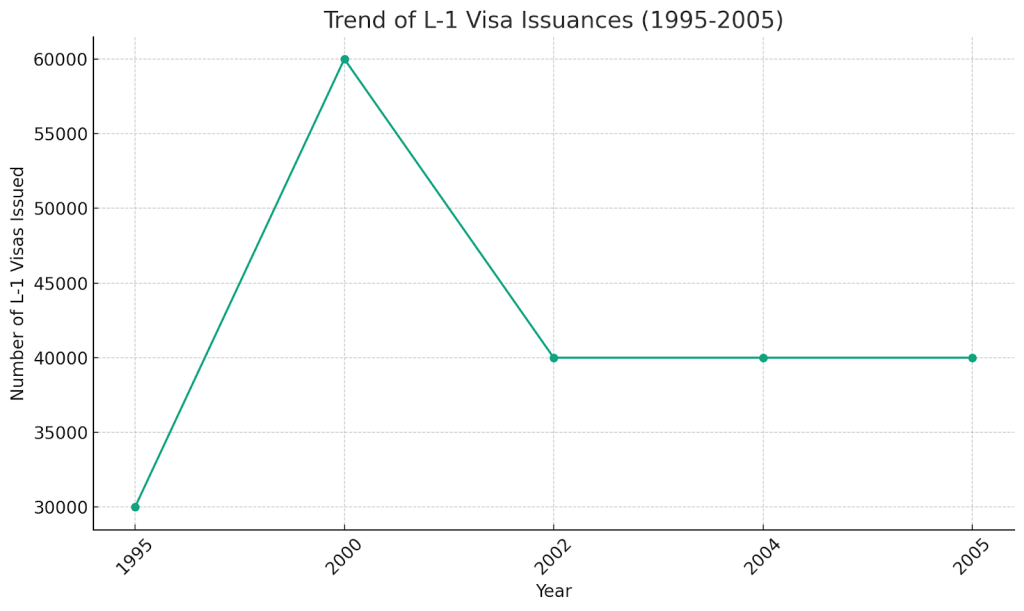
The last decade has witnessed a remarkable surge in L-1 visa issuances, a clear indicator of the increasing globalization of the workforce, particularly in the technology sector. Originating as a tool for multinational companies to transfer key employees across borders, the L-1 visa has evolved into a strategic asset in the global business landscape.
The Rise in Numbers
The data from 1995 to 2005 paints a vivid picture of this trend. In 1995, the number of L-1 visas issued was below 30,000. By 2000, this figure had nearly doubled, signifying a rapid expansion in the need for specialized skills in the U.S. market, especially from countries like India. Although the numbers slightly receded post-2000, they consistently hovered above 40,000 annually, underlining the sustained demand for international talent.
The Future of Global Business and L-1 Visa
Adapting to the Evolving Business Landscape
In the rapidly evolving landscape of global business, the L-1 visa’s role is becoming increasingly pivotal. Experts in international business and immigration law offer insights into how this visa category is adapting and remaining relevant. They note that as businesses become more globalized, the need for a flexible, efficient visa process for international talent is more critical than ever.
Predicting Trends in International Business Mobility
The future of international business will likely see increased mobility of skilled workers, driven by global expansion strategies and the need for a diverse, experienced workforce. Experts predict a growing reliance on visas like the L-1 as businesses seek to position themselves strategically on the global stage.
Impact of Changing Immigration Policies
Immigration policies are in constant flux, and any changes can significantly impact the L-1 visa program. Experts emphasize the importance of staying abreast of these changes, as they can affect the ability of businesses to transfer employees and execute global strategies. The adaptability of the L-1 visa to these policy shifts is seen as key to its continued relevance.
The L-1 visa offers numerous benefits to global businesses, from enhancing international talent mobility to strengthening competitive advantages. As the world of global business continues to evolve, so too will the role of the L-1 visa, adapting to the changing needs of international companies and the global workforce. This visa category is not just a pathway for employee transfer; it’s a strategic tool for global business dominance.
FAQs on the L-1 Visa
What is the typical process for applying for an L-1 visa, and how long does it last?
The L-1 visa application process involves two main steps: first, the U.S. employer files a petition with U.S. Citizenship and Immigration Services (USCIS), and then the employee applies for the visa at a U.S. embassy or consulate. The duration of the L-1 visa varies; an L-1A visa can last up to seven years, while an L-1B visa is valid for up to five years.
What are the limitations and renewal policies for L-1 visas?
L-1 visa holders must be mindful of the maximum stay allowed. L-1A visas are initially granted for three years and can be extended in two-year increments, with a total limit of seven years. L-1B visas can also be extended, but the total stay cannot exceed five years. These renewals are subject to USCIS approval and depend on the visa holder maintaining their eligibility.
What legal aspects and compliance issues should L-1 visa holders be aware of?
L-1 visa holders and their employers must ensure compliance with all immigration laws. This includes maintaining the qualifying employer-employee relationship and adhering to the terms of the visa regarding the nature of the work and the location of employment. Compliance with these legal aspects is crucial for the validity of the visa throughout its duration.
In conclusion
The L-1 visa emerges as a strategic tool of immense value in the arena of global business. Its role in facilitating the smooth transfer of key employees and executives is pivotal in achieving business expansion across borders. By allowing companies to leverage their international talent effectively, the L-1 visa not only aids in immediate operational needs but also contributes significantly to long-term growth and global dominance. For businesses looking to expand their international footprint and develop a global talent pool, the L-1 visa offers a pathway filled with opportunities for growth and innovation. It stands as a testament to the power of strategic talent mobility in the ever-evolving landscape of global business.