
For countless international students, the F-1 student visa represents a gateway to unparalleled educational and career opportunities in the United States. This visa not only opens doors to some of the world’s leading educational institutions but also paves the way for cultural exchange and global networking. The impact of studying in the U.S. extends beyond academic excellence; it’s a transformative experience that shapes career trajectories and fosters global perspectives.
Understanding the F-1 Visa: Essentials and Eligibility
The Gateway to American Education: The F-1 Visa Explained
The F-1 visa is the standard visa category for international students wishing to pursue academic studies at U.S. colleges, universities, or other academic institutions. Its primary purpose is to provide access to educational opportunities while maintaining stringent adherence to immigration regulations. The visa is designed for those who wish to return to their home countries post-graduation, although there are options for temporary employment in the U.S. related to their field of study.
Eligibility: Who Can Apply for an F-1 Visa?
Eligibility for the F-1 visa hinges on several criteria. Prospective students must have a confirmed place at an institution authorized by the U.S. government to accept international students. They must also prove sufficient financial support to cover tuition and living expenses and demonstrate intent to return home upon completion of their studies. Furthermore, maintaining a full-time student status is crucial throughout the duration of the visa.
Navigating the F-1 Visa Application Process
Step 1: Securing Admission and the I-20 Form
The first step in the F-1 visa application process is gaining admission to a U.S. educational institution certified in the Student and Exchange Visitor Program (SEVP). Once accepted, the student receives Form I-20, the Certificate of Eligibility for Nonimmigrant Student Status, a critical document for the visa application.
Step 2: Paying the SEVIS Fee and Completing Visa Application
After obtaining the I-20 form, the student must pay the SEVIS I-901 fee and complete the online visa application (Form DS-160). This form requires detailed personal and academic information and is the basis for the visa interview.
Step 3: Scheduling and Preparing for the Visa Interview
The next step involves scheduling a visa interview at the nearest U.S. embassy or consulate. Preparation for this interview is key – students should be ready to articulate their study plans, demonstrate financial stability, and convince the consular officer of their intent to return to their home country after their studies.
Step 4: Gathering and Organizing Required Documentation
For the interview, students must organize various documents, including their passport, Form I-20, DS-160 confirmation page, receipt for the visa application fee, financial evidence, and academic records. Being well-prepared with organized documentation can significantly enhance the chances of visa approval.
Top Challenges Faced by F-1 Visa Applicants
1. Academic Requirements and Preparedness
A significant challenge for F-1 visa applicants is understanding and fulfilling the academic requirements of U.S. educational institutions. This includes meeting the admissions criteria of their chosen institution and maintaining satisfactory academic progress throughout their studies.
2. Financial Proof and Sponsorship
Demonstrating financial stability to cover tuition and living expenses is a major hurdle. Applicants often need to provide proof of sufficient funds or secure sponsorship, which can be daunting for many.
3. Administrative Processing and Wait Times
Navigating the administrative aspects of the F-1 visa process, including potentially lengthy processing times and bureaucratic hurdles, can be a source of anxiety and uncertainty for applicants.
4. Language and Cultural Integration
Overcoming language barriers and adapting to cultural differences in the U.S. pose challenges for many international students. This includes not only proficiency in English but also adjusting to different educational and social environments.
5. Adapting to Immigration Policy Changes
The ever-changing landscape of immigration policies and guidelines in the U.S. can affect visa processes and requirements, necessitating a constant state of alertness and adaptability from applicants.
Stable Economic Impact of F-1 International Students (2021-2022 & 2022)
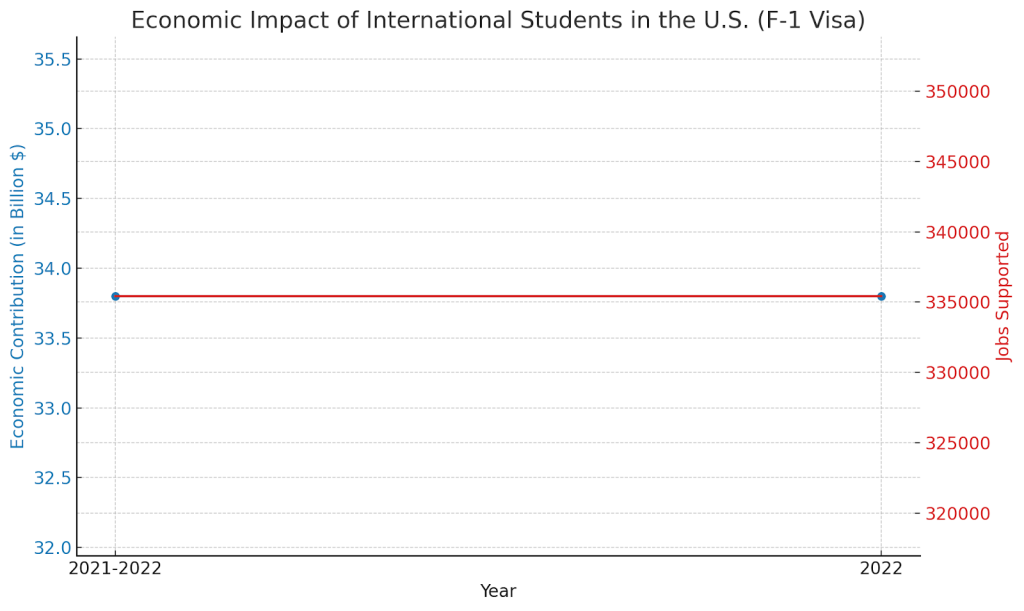
The graph presents the consistent economic contribution of international students on F-1 visas in the United States during the academic years 2021-2022 and 2022. Despite global challenges and shifts in international education dynamics, these students continuously play a crucial role in the U.S. economy. The data highlights their significant financial input of $33.8 billion each year and the steady support of over 335,000 jobs. This stability underlines the enduring importance of international students to the U.S. educational system and economy.
The Future of International Education in the U.S.
Insights into an Evolving Educational Landscape
Experts in the field of international education emphasize the dynamic nature of U.S. higher education, particularly for international students. They note that U.S. institutions continue to attract a diverse international student body due to their academic excellence and extensive opportunities.
Impact of Policy Shifts and Global Dynamics
Recent shifts in policies and global dynamics have had significant impacts on international education. Experts discuss how changes in visa regulations, geopolitical relations, and global events like the COVID-19 pandemic reshape the landscape of international student mobility and higher education strategies.
Universities’ Role in Navigating Visa Processes
A key topic of discussion is the proactive role universities and colleges play in supporting international students, especially with visa processes. Institutions are increasingly offering comprehensive services, from visa application assistance to cultural integration programs, recognizing the value that international students bring to their campuses.
The future of international education in the U.S. is one of adaptation and resilience, with universities, policymakers, and students working together to navigate the complexities of international education. As the landscape continues to evolve, the commitment to fostering a diverse and inclusive academic environment remains a priority for U.S. higher education institutions.
FAQs on the F-1 Visa Journey
How do F-1 visa holders maintain their visa status, and what are their work opportunities?
F-1 visa holders must maintain their status by staying enrolled and making satisfactory academic progress in their programs. Regarding work, they are generally allowed to work on-campus. For off-campus employment, they may qualify for programs like Curricular Practical Training (CPT) during their studies and Optional Practical Training (OPT) post-graduation, which allow them to work in fields related to their study.
What should students know about F-1 visa renewals and travel?
While the F-1 visa is typically valid for the duration of the academic program, students may need to renew it for travel purposes. If traveling abroad, it’s essential to ensure that the visa and other documents, such as the I-20 form, are current to avoid issues upon re-entry to the U.S.
How should students handle F-1 visa denials?
In case of an F-1 visa denial, students should understand the specific reasons for the denial, which can range from insufficient financial proof to doubts about their intent to return to their home country after studies. It’s important to address these reasons comprehensively in any subsequent application to improve the chances of approval.
In conclusion
The journey of an F-1 visa student is one of ambition, resilience, and transformation. This visa category stands as a pillar in international education, enabling students worldwide to access the renowned academic landscape of the U.S. and contribute to its diverse educational environment. For prospective international students, the F-1 visa is not just a document; it’s a ticket to unparalleled educational opportunities, personal growth, and career development. With the right preparation, knowledge, and determination, students can successfully navigate the F-1 visa process and embark on a rewarding educational adventure in the United States.