

Owning property in the United States is an attractive prospect for many international investors and homebuyers. The U.S. real estate market offers stability, potential for appreciation, and the prestige of owning a piece of the American dream. However, a common question among foreign buyers is whether purchasing property in the U.S. can lead to a visa or permanent residency. This article explores the possibilities, challenges, and strategies for aligning property investment with U.S. immigration goals.
Understanding the Basics: Property Ownership vs. Visa Eligibility
Purchasing property in the United States, whether it’s a luxurious apartment in New York City or a vacation home in Florida, does not automatically grant the buyer any immigration benefits. The U.S. does not have a specific “property investor” visa, and owning real estate alone does not provide a path to permanent residency or citizenship. This is an important distinction for potential investors to understand: property ownership does not equate to legal residency.
However, owning property can play a role in visa applications, particularly when it is part of a larger investment or business strategy. The key is to explore visa options that recognize investment activities, including those that might involve real estate.
Visa Options for Real Estate Investors
While there is no direct visa for property ownership, there are several visa categories where investment in U.S. real estate could be part of a broader qualifying investment. These include:
- B-1 Visa (Business Visitor Visa): This visa allows foreign nationals to enter the U.S. for business-related activities, such as meeting with partners, attending conferences, or exploring investment opportunities. While the B-1 visa can be used to investigate potential real estate investments, it does not permit residency or extend beyond the specific business activity.
- E-2 Treaty Investor Visa: The E-2 visa is available to nationals of countries that have a treaty of commerce and navigation with the U.S. To qualify, the investor must make a substantial investment in a U.S. business, which could include real estate if it is part of an active enterprise rather than a passive investment. For example, buying a hotel or an apartment complex that requires active management could qualify. The E-2 visa is renewable indefinitely, but it does not lead directly to a Green Card.
- EB-5 Immigrant Investor Program: The EB-5 program is a more direct path to permanent residency, offering a Green Card to those who invest $900,000 to $1.8 million in a U.S. business that creates at least 10 full-time jobs. Real estate can be a part of this investment, particularly if it involves commercial properties or development projects. The EB-5 program is one of the few investment pathways that lead directly to a Green Card, making it a popular option for those who can meet its stringent requirements.
Challenges and Considerations
Investing in U.S. real estate with the goal of obtaining a visa involves navigating several challenges. The EB-5 program, for example, requires significant financial commitment and meticulous documentation to prove that the investment meets the necessary criteria. This includes demonstrating that the investment will create or preserve the required number of jobs and that the investor is actively involved in managing the business.
For the E-2 visa, the challenge lies in proving that the investment is substantial and that the business is not marginal, meaning it must generate more than enough income to provide a living for the investor and their family. Additionally, the E-2 visa is only available to nationals of certain countries, and it does not provide a direct path to permanent residency, which may not be suitable for those looking for a long-term solution.
Legal and Financial Implications
When investing in U.S. real estate as part of a visa strategy, it’s crucial to consider the legal and financial implications. Property ownership comes with responsibilities, including paying property taxes, dealing with capital gains taxes upon sale, and adhering to local zoning laws and regulations. Foreign investors also need to be aware of the Foreign Investment in Real Property Tax Act (FIRPTA), which requires withholding a percentage of the sale price for tax purposes if the property is sold.
Moreover, real estate investments tied to visa applications must be carefully structured to comply with U.S. immigration laws. Working with immigration attorneys who specialize in investor visas and tax advisors knowledgeable about international investments is essential to avoid legal pitfalls and maximize the chances of success.
Combining Property Investment with Business Ventures
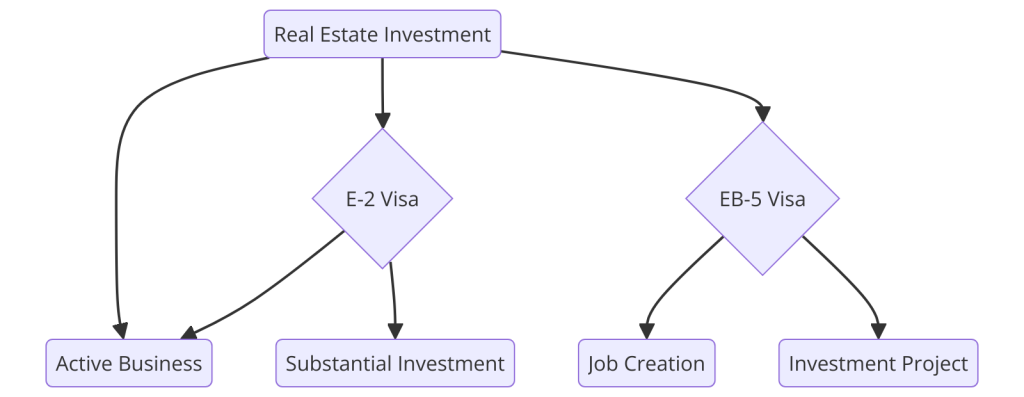
One effective strategy for aligning property investment with immigration goals is to combine real estate purchases with business ventures that qualify for investor visas. For instance, purchasing commercial property to house a new business or investing in a real estate development project that creates jobs can make the investment eligible for visas like the E-2 or EB-5. This approach allows investors to leverage their real estate investments while meeting the active business requirements of these visas.
For example, a foreign national could purchase a small hotel or resort in the U.S., actively manage the business, and qualify for an E-2 visa. Similarly, investing in a residential development project that creates construction and management jobs could fulfill the requirements of the EB-5 program.
The Role of Due Diligence
Due diligence is critical when considering property investment as part of your immigration strategy. This includes thorough research into potential properties, understanding the local real estate market, and ensuring that the investment meets all legal requirements. Due diligence also involves assessing the long-term viability of the investment, especially if it is tied to a visa program that requires active business involvement and job creation.
Engaging professionals who specialize in real estate and immigration law can help investors navigate the complexities of U.S. regulations, avoid common pitfalls, and make informed decisions. This includes understanding the specific requirements of the visa program you are applying for and ensuring that your investment aligns with those criteria.
Alternative Visa Options for Entrepreneurs and Investors
Beyond the specific investor visas like E-2 and EB-5, other visa options might align with property and business investments. For instance:
- L-1 Visa (Intracompany Transferee Visa): This visa allows multinational companies to transfer executives or managers to their U.S. offices. While real estate ownership alone does not qualify for an L-1 visa, establishing a U.S. office as part of a real estate business could facilitate eligibility for this visa.
- O-1 Visa (Extraordinary Ability Visa): The O-1 visa is for individuals with extraordinary abilities in their field, such as business, science, or arts. While not directly tied to real estate, successful entrepreneurs who have achieved significant success in real estate development or management could potentially qualify under this category.
These alternative options offer different pathways depending on the investor’s background, the nature of the investment, and long-term immigration goals.
In Conclusion
While purchasing property in the United States does not directly lead to visa eligibility, it can be part of a broader strategy that aligns with certain investment visa requirements. Understanding the specific pathways, such as the E-2 and EB-5 visas, and working with experienced professionals, can help investors navigate the complexities of U.S. immigration law and maximize their chances of achieving residency in the U.S.
By being well-informed and strategically planning your investments, you can make the most of the opportunities available in the U.S. real estate market while working towards your long-term immigration goals. Whether you’re looking to invest in a commercial property as part of a business venture or contribute to economic growth through real estate development, there are pathways available that, with careful planning and due diligence, can help you achieve your American dream.