
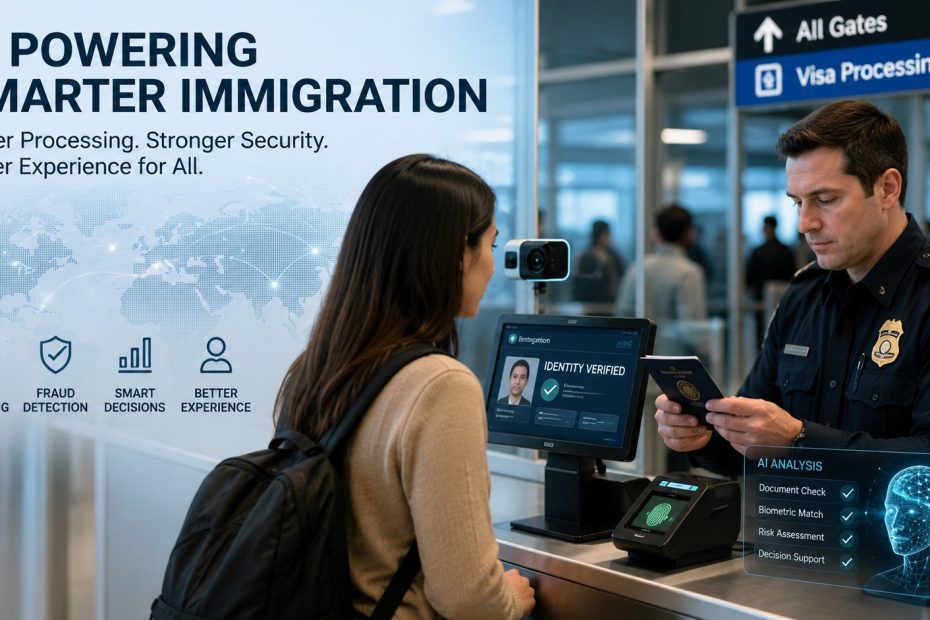
AI immigration systems are speeding up parts of immigration by sorting applications, translating records, checking document quality, matching identities, and routing routine files to officers. They can reduce clerical delay, but they should not replace legal judgment; you still need an accurate file and a real route to human review when an automated step gets something wrong.
This guide explains what immigration agencies are automating, where measured gains have appeared, and what those gains do—and do not—mean for your visa, residence, citizenship, or border process. It focuses on official evidence from the United States, Canada, and the European Union available through July 30, 2026, with practical steps you can use before you submit an application or travel.
The most useful way to read the technology is by task, not by the label attached to it. Agencies use machine learning, advanced analytics, rules-based automation, biometrics, and generative AI for different jobs, and an agency may not classify every automated tool as AI.
What Does AI Actually Do in Immigration?
AI usually assists with a narrow task inside a larger immigration process. It may classify a document, extract data, translate text, compare a live face with a stored travel image, summarize case notes, or identify which officer has the right expertise for a file.
That distinction matters because “AI decided my case” can describe several very different situations. A translation tool may influence how quickly an officer can read evidence. A triage model may decide which queue receives your file. A risk tool may trigger extra review. A generative tool may draft a summary that an employee is expected to check. Each step can affect timing, yet only some steps affect the legal outcome directly.
The U.S. Government Accountability Office’s July 2025 review found that U.S. Citizenship and Immigration Services was developing AI and generative AI capabilities for document translation across document types. GAO said the planned use could improve the timeliness of translations. That is a strong use case because translation is repetitive and time-consuming, but the translated text still needs quality controls when a word, date, name, or legal phrase could change the meaning of the evidence.
Canada’s immigration department describes a wider set of tasks. Its February 2026 technology disclosure says advanced analytics and automation can make some positive decisions on routine cases, route applications by required expertise, identify files that may need extra checks, create basic summaries for officers, and help answer client inquiries. Those jobs are related, but they carry different risk: routing a file is not the same as deciding eligibility.
How Does AI Make Visa Processing Faster?
AI makes processing faster when it removes repetitive work before an officer reaches the legal questions. The clearest measured result comes from Canada’s temporary resident visa program, where advanced analytics separated routine files from non-routine ones and assigned work more efficiently.
In a January 2022 official notice, Immigration, Refugees and Citizenship Canada reported that its analytics system had helped sort and process more than one million temporary resident visa applications since 2018 in high-volume locations. IRCC said routine files were assessed 87% faster with the system. That figure describes the assessment of routine files within the program; it is not proof that every applicant received a final decision 87% sooner.
IRCC said the tool could identify a routine applicant as eligible, then send the file to an officer for admissibility checks and the final decision. Non-routine cases could be directed to officers according to complexity. The gain came from reducing clerical sorting and making the queue more purposeful, not from asking a general chatbot to interpret immigration law.
- Data capture: Read structured fields and reduce manual re-entry.
- Document handling: Classify, translate, and organize evidence for review.
- Queue management: Separate routine work from files needing specialist attention.
- Identity verification: Compare biometric information with an existing travel record.
- Applicant service: Route inquiries, provide status tools, and support digital responses.
- Quality control: Flag missing, conflicting, or unusual information for an employee to examine.
Speed depends on clean inputs. A misspelled name, inconsistent date format, poor scan, incomplete translation, or document placed in the wrong category can interrupt the automated path and send the file into manual review. You gain more from automation when your submission is organized, legible, internally consistent, and matched to the official checklist.
Where Is USCIS Using AI?
USCIS has reported AI work in service delivery, document handling, fraud detection, screening, and internal operations, but each listed use has its own purpose and risk level. The agency’s public inventory is the right place to check a named system rather than assuming that every digital USCIS feature uses AI.
The USCIS AI use-case inventory is published through the Department of Homeland Security and was updated in July 2026. Inventories matter because they let you separate a documented government use from marketing claims made by software vendors, immigration-service websites, or social-media creators.
GAO’s 2025 report gives one verified USCIS example: the document-translation project noted earlier. It also shows why agencies are adding AI quickly. Across 11 selected federal agencies, reported AI use cases rose from 571 in 2023 to 1,110 in 2024; reported generative-AI cases rose from 32 to 282. Those totals cover all 11 agencies, not immigration alone, so they measure the pace of federal adoption rather than the number of immigration decisions made with AI.
Takeaway: Federal AI adoption expanded quickly, including work at USCIS, but this chart does not count immigration decisions or measure applicant outcomes.
Source: U.S. Government Accountability Office, GAO-25-107653, published July 29, 2025. Data as of July 29, 2025. Values are reported agency use cases, not unique AI systems; one system may support more than one use.
This growth creates two practical needs. Agencies must publish enough detail for the public to understand what a tool does, and staff must know where a machine-produced translation, score, or summary enters the file. Without that chain, an applicant may see a delay or request for evidence without knowing whether the underlying problem began with the submitted document, a software output, or an officer’s interpretation.
Can AI Approve or Deny Your Visa?
The answer depends on the country, program, and type of decision. Some systems can make a positive eligibility determination in a narrow class of routine cases, but major immigration authorities still describe refusal and final admissibility decisions as human responsibilities.
Canada provides unusually specific public wording. IRCC said its temporary resident visa analytics system could determine eligibility for a routine application, but “The system never refuses or recommends refusing applications.” An officer still assessed admissibility and made the final decision. IRCC also said officers could overturn an automated eligibility determination.
That design reduces one serious risk: a negative legal outcome should not be produced only because a model placed a person in the wrong category. It does not remove every risk. Triage can still influence waiting time, the level of scrutiny, and which evidence an officer sees first. A human signature at the end does not prove that every automated input was accurate.
U.S. federal policy draws a similar line around consequential systems. The April 2025 Office of Management and Budget memorandum M-25-21 defines high-impact AI as a use whose output serves as a principal basis for an action with a legal, material, binding, or significant effect on rights or safety. It requires testing, impact assessment, monitoring, and suitable human oversight for covered high-impact uses. The memorandum says an agency must discontinue a non-compliant use and “cease the use of the AI” when proper risk mitigation is not possible.

The applicant-facing digital layer is also easy to confuse with automated decision-making. USCIS has promoted online accounts for tracking pending forms, receiving secure messages, and responding to requests for evidence. Those functions can save mailing time and create a clearer record, yet the existence of an online account does not tell you whether AI touched the adjudication.
What Does Facial Recognition Change at the Border?
Facial recognition can replace or speed part of the identity-checking step, but it does not answer every legal question about admission. A camera captures a live image, the system compares it with an existing travel image, and an officer uses the result during inspection or boarding.
A July 2022 GAO review reported that CBP had deployed facial recognition for arriving international travelers at all U.S. airports and for departing travelers at 32 airports, counting six locations where the technology had been piloted or previously deployed. GAO also noted that the system’s purpose was biometric identity confirmation and entry-exit record creation, not a stand-alone ruling on whether a traveler qualified for admission.
The efficiency gain is easy to see: a face comparison can connect the traveler at the checkpoint to an existing passport or travel record without repeated manual inspection of the same fields. The risk lies in false matches, poor image quality, unclear notice, or staff treating a score as conclusive. GAO’s earlier work found shortcomings in privacy notices and partner auditing, then tracked agency actions responding to its recommendations.

CBP’s official video below shows its Simplified Arrival process at Los Angeles International Airport. Watch the sequence: the technology performs the identity comparison, then the traveler continues through an officer-led border process. The footage is useful operational evidence, but it is an agency presentation rather than an independent test of error rates or traveler experience.
Digital travel tools can remove another manual step before inspection. In 2020, the official LAX account highlighted Mobile Passport as a way for eligible U.S. and Canadian citizens to submit information through an app and proceed to a CBP officer. The post predates several newer border systems, so it documents the direction of applicant-facing automation rather than the present availability of every feature.
What Benefits Can You Expect as an Applicant or Traveler?
You are most likely to notice faster handling of routine work, fewer repeated data-entry steps, better routing, and quicker access to status or document requests. You should not assume that AI will shorten every case or remove interviews, security checks, medical requirements, document verification, or statutory waiting periods.
The strongest benefit appears when a large share of files follow predictable patterns. Canada’s measured gain on routine temporary resident visa assessment shows how triage can free officers to spend more time on non-routine files. USCIS translation work could address a similar bottleneck by reducing the time needed to make documents readable to adjudicators.
Consistency may improve when the same document type is classified by a tested tool rather than handled differently across offices. A reliable system can route a technical employment petition to a team with the right expertise or flag a missing page before weeks are lost. Yet consistency is only valuable when the rule itself is correct and the tool performs well across languages, name formats, document styles, ages, and image conditions.
You may also get a better record of communication. Secure inboxes, electronic notices, online evidence submission, and status tools can reduce dependence on postal delivery. These features are often ordinary software rather than AI, but they are part of the same modernization effort and may produce a more immediate benefit than a hidden model operating inside an agency.
The practical test is not whether an agency says it uses AI. Ask whether the named tool reduced a specific processing step, whether the result was measured, whether the measure covers applicants like you, and whether a person can correct an error. A broad claim about efficiency carries little value without those details.
What Are the Biggest Risks of AI Immigration Systems?
The main risks are inaccurate inputs or outputs, opaque triage, biased performance, excessive data collection, weak human review, and no workable correction path. Immigration files contain names from many writing systems, changing addresses, family relationships, travel history, sensitive records, and legal categories; a small data error can travel through several connected systems.
Automation can create a false sense of certainty. An officer may give too much weight to a risk flag, machine translation, or generated summary because it appears standardized. This is often called automation bias. Human review works only when the reviewer has time, access to the underlying evidence, authority to disagree, and a record showing why the machine output was accepted or rejected.
Data collection creates a separate risk. Associated Press reporting from March 2025 described a U.S. proposal to collect social-media handles from more immigration-benefit applicants and reported expert concerns about using AI to interpret large amounts of social data. Social posts can be sarcastic, translated poorly, shared by another person, or detached from their original thread. Automated screening may help locate material for review, but it cannot safely replace careful authentication and human interpretation.
European law treats several migration uses as high risk. The EUR-Lex summary of the EU Artificial Intelligence Act lists systems used to assess risks tied to migration, asylum, and visa applications, or to detect and identify people in migration settings, among high-risk categories. The classification does not ban every use; it signals that documentation, testing, oversight, and rights protections must match the possible harm.
Canada’s published safeguards for the temporary resident visa system include an algorithmic impact assessment, review for possible discriminatory effects, privacy and security measures, and officer authority to overturn the automated eligibility result. Those controls are valuable, but an agency’s description is not the same as independent proof that every group receives equal performance. Public reporting should include test design, error measures, changes made after monitoring, and the limits of any published result.
A useful discussion of the dispute appears in the Bipartisan Policy Center’s October 2024 episode on AI in immigration. It brought together policy analysis of DHS and USCIS adoption with the objections of Paromita Shah of Just Futures Law, whose coalition had urged DHS to stop certain AI uses. The episode does not settle the issue; it shows why efficiency claims must be tested against privacy, fairness, and accountability concerns.
Listen to the Bipartisan Policy Center episode “AI in Immigration – Incorporating Emerging Technologies in Immigration Processes”. The publisher page provides the episode description and participants. It is linked rather than placed in an iframe because the page does not supply a verified WordPress video embed.
How Can You Protect Your Application When AI Is Involved?
Build a file that is easy for software and people to read, then preserve enough evidence to challenge a mistake. You cannot control an agency’s internal system, but you can reduce avoidable mismatches and make any later correction more specific.
- Use the official form version. Confirm the edition date, instructions, fee, filing location, and accepted submission method on the agency website.
- Keep identity fields identical. Match names, dates of birth, passport numbers, prior identifiers, and transliterations unless the form asks for an alternate version.
- Upload clean files. Use complete, upright, legible scans with every page present and no cropped seals, signatures, or document numbers.
- Label translations precisely. Preserve the original, the full translation, and any required translator certification as separate files with precise names.
- Explain real differences. Address a changed surname, conflicting date format, old address, missing record, or spelling variation instead of leaving the reviewer to infer the reason.
- Save the submission record. Retain the final forms, evidence, upload confirmation, payment record, notices, messages, and the exact version sent.
- Read every notice literally. Compare a request for evidence or refusal reason with the material you supplied; answer the stated gap rather than uploading an unorganized second copy of the whole file.
- Use qualified legal help when the stakes are high. A chatbot can help organize questions, but it cannot verify that changing law, policy, and case-specific facts were applied correctly.
Do not paste confidential immigration records into a public chatbot unless you have reviewed the provider’s privacy terms and your adviser has approved the method. Passport pages, identity numbers, financial records, medical documents, family details, and prior immigration history can create lasting exposure if stored, reused, or accessed outside the intended case.
Treat AI-generated form guidance as a draft. Check every answer against the official instructions and the actual facts. Immigration rules change, agency webpages can be updated, and a model may state an old rule with confidence. The safest workflow is official instruction first, organized draft second, line-by-line verification third.
What Should Immigration Agencies Disclose?
An agency should disclose what the system does, where it enters the process, what data it uses, how performance is tested, who can override it, and how you can seek correction. A public list containing only a project name does not give applicants enough information to understand a consequential use.
A useful disclosure separates administrative assistance from decision support. Document translation, appointment scheduling, inquiry routing, biometric identity matching, fraud screening, eligibility recommendation, and final decision support should not be placed under one broad label. The public needs to know whether a tool saves time, changes queue position, triggers scrutiny, recommends an outcome, or supplies text that appears in the case record.
Performance reporting should state the population, period, language, document type, and error measure. A high average accuracy rate can hide weak results for a smaller group or difficult input. Agencies should also report material changes to models, data sources, thresholds, vendors, and human-review rules because an old evaluation may no longer describe the system in use.
Correction must be operational, not theoretical. A person should know which office can examine a disputed output, what evidence to submit, whether processing pauses during review, and how the correction moves to connected records. OMB’s high-impact AI rules and Canada’s published officer-override policy offer useful building blocks, but the applicant experience depends on whether those safeguards work in a real case.
Independent audits add credibility where agency or vendor testing carries an obvious incentive. Auditors need access to representative data, failure cases, documentation, and the human workflow around the model. An audit of the algorithm alone will miss errors caused by scanning equipment, data entry, interface design, workload pressure, or staff training.
Does AI Make Immigration Faster?
- It can speed routine sorting, translation, data checks, and identity matching.
- It cannot remove legal requirements or guarantee a faster final decision.
- Human review and a correction route remain essential.
Use Speed Without Surrendering Review
AI can make immigration administration more efficient when it handles bounded, testable work and leaves consequential judgment with an accountable person. Your practical move is to submit a clean and consistent record, verify every rule through official material, preserve what you filed, and challenge any unexplained mismatch with specific evidence; an agency’s practical duty is to show where automation acts and make correction possible.
References
- Artificial Intelligence: Generative AI Use and Management at Federal Agencies. U.S. Government Accountability Office. July 29, 2025.
- USCIS AI Use Case Inventory. U.S. Department of Homeland Security. Updated July 15, 2026.
- Advanced data analytics to help IRCC officers sort and process temporary resident visa applications. Immigration, Refugees and Citizenship Canada. January 24, 2022.
- How we use advanced analytics, automation and other technologies. Immigration, Refugees and Citizenship Canada. Updated February 20, 2026.
- M-25-21: Accelerating Federal Use of AI through Innovation, Governance, and Public Trust. U.S. Office of Management and Budget. April 3, 2025.
- Rules for trustworthy artificial intelligence in the EU. EUR-Lex. March 11, 2025.
- CBP Traveler Identity Verification and Efforts to Address Privacy Issues. U.S. Government Accountability Office. July 27, 2022.
- U.S. immigration officials look to expand social media data collection. Associated Press. March 30, 2025.
- Ep. 180: AI in Immigration – Incorporating Emerging Technologies in Immigration Processes. Bipartisan Policy Center. October 8, 2024.
- CBP Introduces Simplified Arrival at LAX. U.S. Customs and Border Protection, official YouTube channel. October 29, 2020.
- USCIS online-account service post. U.S. Citizenship and Immigration Services, official X account. August 1, 2022.
- Mobile Passport service post. Los Angeles International Airport, official X account. September 23, 2020.
- Biometric Facial Recognition at Houston International Airport. Wikimedia Commons; U.S. Customs and Border Protection photograph by Donna Burton. Photographed February 13, 2018; licence reviewed June 14, 2025.
- Sample Immigration Documents used in Checks of the SAVE System. Wikimedia Commons; U.S. Government Accountability Office. April 10, 2017.