

Navigating the intricate pathways of U.S. immigration can be a daunting endeavor for many. Here, the U.S. Visa Bulletin stands as a beacon, guiding prospective immigrants and legal professionals through the complexities of visa availability and priority dates. This critical document, issued monthly by the U.S. Department of State, plays a pivotal role in shaping the immigration journey for thousands, making its understanding and interpretation a key aspect for anyone involved in or aspiring to embark on U.S. immigration.
Understanding the Visa Bulletin: A Comprehensive Guide
Deciphering the Essence of the Visa Bulletin
The Visa Bulletin is more than just a government publication; it is an essential tool that demystifies the timing and availability of immigrant visas. Designed for both family-sponsored and employment-based visa categories, it is pivotal in planning the immigration process. The bulletin outlines who can apply for a visa and when, based on the applicant’s priority date — the date when the U.S. Citizenship and Immigration Services (USCIS) received the visa petition.
Breaking Down the Bulletin’s Structure
The Visa Bulletin is divided into several key sections, each serving a distinct purpose in the immigration process. The ‘Family-Sponsored Preferences’ and ‘Employment-Based Preferences‘ sections list the priority dates that are currently being processed. The bulletin also includes ‘Final Action Dates’ and ‘Dates for Filing Applications,’ providing a clear picture of the visa availability and application timeline. Understanding each section’s role is crucial for applicants to gauge their position in the visa queue and to strategize their immigration journey.
Navigating the Visa Bulletin
Step-By-Step Interpretation of the Visa Bulletin
Navigating the Visa Bulletin involves understanding its monthly updates and how they apply to individual cases. The first step is identifying the relevant preference category and then comparing the priority date with the dates listed in the bulletin. If the priority date is before the date listed, the applicant can proceed with their visa application.
Strategic Use of the Visa Bulletin
To effectively use the Visa Bulletin, it is crucial to monitor it regularly and understand its implications for visa availability. This vigilance allows for timely adjustments in immigration plans. Additionally, interpreting the movement of dates within the bulletin can offer insights into the likely waiting periods and help in planning the immigration timeline accordingly.
Insights from the Visa Bulletin: Navigating U.S. Immigration Trends
Trends and Changes in U.S. Immigration Policy
The Visa Bulletin is a dynamic document that mirrors the evolving landscape of U.S. immigration policy. By scrutinizing the monthly changes in visa availability and priority dates, one can discern shifts in immigration policy priorities. For instance, alterations in the processing speed of certain visa categories may reflect a change in policy focus, whether favoring family reunification or addressing labor market demands through employment-based visas.
The Impact of Priority Dates
Priority dates play a crucial role in the U.S. immigration process, acting as a timestamp for an individual’s place in the visa queue. Understanding how these dates move and what they signify is essential for applicants awaiting their turn to apply for a visa. Fluctuations in these dates can significantly affect application strategies and timelines.
Visa Bulletin’s Effect on Different Visa Categories
The Visa Bulletin affects family-sponsored and employment-based visas differently. Each category experiences its own patterns of movement and backlog, influenced by factors like annual visa caps and per-country limits. For family-sponsored visas, wait times can vary greatly depending on the category and the applicant’s country of origin. Employment-based visas, on the other hand, may see faster movements, albeit with fluctuations based on the labor market’s demand for specific skills.
Seasonal and Annual Patterns in Visa Availability
The Visa Bulletin often exhibits seasonal and annual patterns in visa availability and processing times. These patterns can be influenced by annual visa quotas, processing efficiencies, and changes in immigration law or policy. Recognizing these patterns can aid applicants in predicting potential wait times and planning their immigration journey more effectively.
Major Advancements in Employment-Based Visa Categories – October 2023
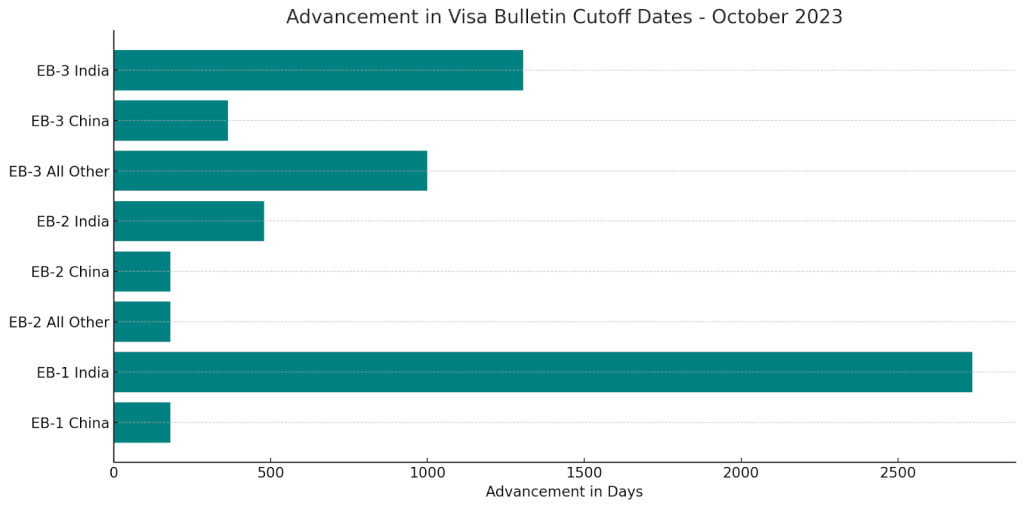
The graph provides a detailed visualization of the significant advancements in the cutoff dates for various employment-based visa categories, as reported in the October 2023 Visa Bulletin. Remarkable progress is seen in the EB-1 category for India, with an advancement of over seven years, indicating a substantial easing in the backlog for Indian applicants in this category. Similarly, the EB-3 category shows major advancements for ‘All Other’ areas and Mexico, moving nearly three years forward. These shifts reflect a concerted effort by the U.S. immigration system to address longstanding backlogs and improve processing times for employment-based visas.
The Future of U.S. Immigration as Told by the Visa Bulletin
Analyzing Visa Bulletin Trends for Future Predictions
Experts in immigration law and policy scrutinize the Visa Bulletin for insights into the future of U.S. immigration. Changes observed in the bulletin, such as faster or slower movements in certain categories, can indicate upcoming shifts in immigration policies or priorities. These analyses are crucial for predicting how the U.S. immigration landscape might evolve in the coming years.
Influence of Policy Shifts and Global Events
The Visa Bulletin is not only influenced by U.S. immigration policies but also by global events and international relations. Changes in U.S. foreign policy, global migration trends, or significant events like economic shifts and crises can all impact how and when visas are allocated, as reflected in the bulletin.
Shaping Immigration Through the Visa Bulletin
The Visa Bulletin plays a significant role in shaping and responding to immigration trends. It functions as both a mirror and a mold, reflecting current immigration realities while also influencing future flows and patterns of migration. As a critical tool for both applicants and policymakers, the Visa Bulletin’s monthly updates offer a glimpse into the ever-changing world of U.S. immigration, providing guidance and insight for navigating this complex terrain.
FAQs on Utilizing the Visa Bulletin
How should applicants interpret and apply the information in the Visa Bulletin?
Applicants should use the Visa Bulletin to understand when their visa applications might be processed. The bulletin lists priority dates, which are crucial in determining an applicant’s place in the visa queue. Applicants need to compare their own priority date — the date when their visa petition was filed — with the dates listed in the bulletin for their specific visa category and country of origin to gauge when their application might move forward.
What is the significance of priority dates in the Visa Bulletin?
Priority dates in the Visa Bulletin indicate when visas are available for different categories and countries of origin. These dates determine when an applicant can expect their visa application to be processed, based on their place in the queue. Understanding one’s priority date in relation to the bulletin is key to predicting the timeline for visa application processing.
What is a common misconception about the Visa Bulletin?
A common misconception is that the Visa Bulletin applies to all types of U.S. visas. In reality, the bulletin specifically pertains to immigrant visas, especially those in family-sponsored and employment-based categories. It does not apply to non-immigrant visa categories like tourist, student, or temporary work visas.
What is the difference between ‘Final Action Dates’ and ‘Dates for Filing Applications’ in the Visa Bulletin?
The ‘Final Action Dates’ in the Visa Bulletin indicate when visas can actually be issued to applicants, while the ‘Dates for Filing Applications’ show when applicants can begin submitting their visa applications or adjustment of status applications. Both sections serve different purposes and are important for different stages of the visa application process.
What should applicants do while waiting for their priority dates to become current?
Applicants waiting for their priority dates to become current should regularly check the Visa Bulletin to stay updated on the movement of dates. They should also prepare all necessary documentation and be ready to proceed with their application once their priority date becomes current. Additionally, staying informed about any changes in U.S. immigration policy is crucial, as these changes could impact the visa application process.
In conclusion
The Visa Bulletin stands as a crucial tool in the intricate landscape of U.S. immigration, guiding applicants through a process that can often seem daunting and opaque. It provides not just dates and numbers, but a roadmap for those seeking to navigate the complex journey towards U.S. residency. Regular consultation of the Visa Bulletin, combined with a clear understanding of its contents, is essential for anyone looking to achieve a successful outcome in their U.S. immigration endeavors. For aspiring immigrants, the Visa Bulletin is more than just a monthly publication; it’s a beacon of hope, illuminating the path to achieving their American dream.