

The concept of birthright citizenship stands as one of the most defining principles of American identity, enshrined within the fabric of the nation’s legal and cultural tapestry. Rooted deeply in the 14th Amendment of the U.S. Constitution, this principle automatically confers citizenship to all individuals born within the United States and its territories. Beyond its legal definition, birthright citizenship represents a powerful embodiment of the American ethos—promising equality, opportunity, and belonging to every person born on its soil, irrespective of their parents’ nationality or status. This introductory exploration seeks not only to trace the historical and legal underpinnings of this right but also to contextualize its significance in the ongoing narrative of American democracy.
Historical Overview and Legal Foundations
The journey of birthright citizenship from a contested notion to a cornerstone of American civil rights underscores a significant evolution in the country’s approach to citizenship and inclusion. The pivotal moment came with the ratification of the 14th Amendment in 1868, a transformative period marked by the nation’s reckoning with its Civil War and the imperative of integrating freed slaves into the American polity. The Amendment’s Citizenship Clause was clear: “All persons born or naturalized in the United States, and subject to the jurisdiction thereof, are citizens of the United States and of the State wherein they reside.” This clause not only overturned prior rulings, such as the infamous Dred Scott decision, which denied citizenship to African Americans but also laid the groundwork for inclusive citizenship irrespective of race.
However, the application and interpretation of birthright citizenship have not been without challenges. The case of Wong Kim Ark in 1898 is particularly illustrative, marking a significant legal affirmation of the principle of jus soli—right of the soil. Wong Kim Ark, a U.S.-born son of Chinese immigrants, found himself at the heart of a legal battle upon being denied re-entry to the U.S. after visiting China. The Supreme Court’s ruling in his favor not only underscored the unequivocal grant of citizenship to all born on U.S. soil but also established a precedent that has withstood various legal and political challenges to date. This ruling reinforced that birthright citizenship applies universally to all born within the United States, irrespective of their parents’ nationality, effectively integrating generations of immigrants into the American societal fabric.
The evolution of birthright citizenship from a post-Civil War reconstruction effort to a well-established legal right reflects the nation’s broader journey towards realizing its ideals of equality and justice. Despite ongoing debates and challenges, the enduring principle of birthright citizenship continues to stand as a testament to the inclusive vision that the United States strives to uphold, welcoming every person born on its soil into its national community.
The Principle of Jus Soli and Jus Sanguinis
The United States’ approach to citizenship is primarily anchored in the principle of jus soli, or “right of the soil,” which grants automatic citizenship to individuals born within its territories. This principle, enshrined in the 14th Amendment of the U.S. Constitution, establishes a clear, inclusive basis for citizenship, distinct from the principle of jus sanguinis, or “right of blood,” which confers citizenship through parental nationality. Unlike many countries in Europe that prioritize jus sanguinis, emphasizing lineage over birthplace, the U.S. model of jus soli embodies a more open and inclusive approach to nationality, reflecting the nation’s history as a melting pot of cultures and identities.
The application of jus soli extends to U.S. territories, with certain nuances. Individuals born in incorporated territories of the U.S. are automatically U.S. citizens at birth. However, the specifics can vary; for example, persons born in American Samoa are considered U.S. nationals but not citizens, a distinction upheld by federal courts. This status highlights the complex interplay between historical, legal, and geopolitical factors that shape citizenship laws across different U.S. territories.
Challenges and Controversies
The principle of birthright citizenship, while foundational to the U.S. legal system, has not been without its controversies and challenges. A significant area of debate centers on the citizenship of children born to undocumented immigrants. Critics argue that the 14th Amendment does not explicitly cover children of undocumented parents, a position not supported by federal courts. This debate intersects with concerns over “birth tourism,” where individuals enter the U.S. specifically to give birth, ensuring citizenship for their child. The Trump administration attempted to address this by implementing policies to restrict access to birthright citizenship in certain contexts, reflecting broader national conversations on immigration and citizenship.
These debates underscore the ongoing evolution of citizenship laws in response to shifting societal, political, and legal landscapes. While the principle of jus soli remains a cornerstone of U.S. nationality law, its application and interpretation continue to provoke discussion and legal scrutiny, reflecting the complex, often contentious nature of citizenship in a globalized world.
Citizenship by Parentage
The acquisition of U.S. citizenship through parentage is governed by a combination of constitutional amendments, statutes, and case law, providing a pathway for children born to U.S. citizens—whether within the country or abroad—to inherit their parents’ citizenship. This process is rooted in the principle of jus sanguinis (“right of blood”) and is detailed in the Immigration and Nationality Act (INA).
For children born within the U.S. to at least one U.S. citizen parent, citizenship is typically automatic. The situation becomes slightly more complex for children born abroad. In these cases, at least one parent must be a U.S. citizen at the time of the child’s birth, and certain residency requirements must be met by the U.S. citizen parent prior to the child’s birth. This ensures the transmission of citizenship through bloodline while maintaining a tangible connection to the United States.
Adopted children of U.S. citizens also have a clear path to citizenship, especially through processes like the Child Citizenship Act, which automatically confers citizenship to foreign-born adopted children of U.S. citizens, assuming certain legal and residency conditions are met. This reflects a broader understanding of family and nationality, recognizing the bonds formed through adoption as equal to those of blood for the purposes of nationality transmission.
The Impact of Birthright Citizenship
Birthright citizenship has profound implications for American society, influencing the nation’s demographic composition, its approach to immigration, and the concept of national identity. Annually, a significant number of children born in the U.S. to undocumented immigrants are granted citizenship, contributing to a diverse, multicultural citizenry. This policy has not only facilitated the integration of immigrants into American society but also sparked debates over immigration policy and national security.
The impact of birthright citizenship extends beyond legal status, affecting societal cohesion and the economic landscape. By granting citizenship at birth, the U.S. ensures that all children born within its borders have equal rights and opportunities, reinforcing the principle of equality that is central to American democracy. However, this policy also faces criticism from those who argue it may incentivize illegal immigration or “birth tourism,” highlighting the complex interplay between citizenship laws and broader immigration policies.
Birthright Citizenship: A Pillar of American Identity
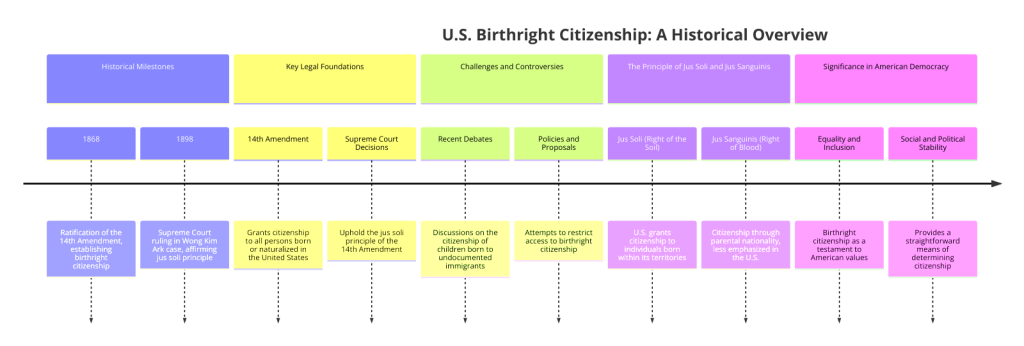
In the vast tapestry of American legal and cultural history, few principles shine as brightly as birthright citizenship. This diagram, titled “U.S. Birthright Citizenship: A Historical Overview,” serves as a visual chronicle of the evolution and challenges of birthright citizenship in the United States. It begins with the pivotal ratification of the 14th Amendment in 1868, a moment that embedded the promise of equality and belonging into the fabric of the nation. The Supreme Court’s decision in the Wong Kim Ark case of 1898 further cemented the jus soli—or “right of the soil”—principle, ensuring that anyone born on U.S. soil would be granted American citizenship.
The timeline proceeds to outline the ongoing debates and policy proposals aimed at restricting this right, reflecting the complex interplay between law, society, and politics. Despite these challenges, the principles of jus soli and jus sanguinis (right of blood) underscore the inclusivity and diversity that birthright citizenship brings to the American identity. It is a testament to a nation’s commitment to equality, opportunity, and inclusion, standing as a beacon of hope and belonging for every person born under its flag.
What Is The 14th Amendment Of The Us Constitution
The 14th Amendment to the U.S. Constitution, ratified on July 9, 1868, is a pivotal piece of legislation that significantly expanded the protections of civil rights within the United States. It was one of the Reconstruction Amendments passed in the aftermath of the Civil War. The amendment comprises several key components:
- Citizenship Clause: It grants citizenship to all persons born or naturalized in the United States, including former slaves, and guarantees them equal protection under the laws of both the United States and the states where they reside.
- Privileges or Immunities Clause: It prohibits states from making or enforcing any laws that abridge the privileges or immunities of citizens of the United States.
- Due Process Clause: It forbids states from depriving any person of life, liberty, or property without due process of law.
- Equal Protection Clause: It requires each state to provide equal protection under the law to all people within its jurisdiction.
- Apportionment of Representatives: It modifies the apportionment of representatives in Congress based on the whole number of persons in each state, excluding non-taxed Native Americans. It also addresses the reduction in representation for states denying the right to vote to male inhabitants over twenty-one years of age, except for participation in rebellion or other crimes.
- Political Office Restrictions: It disqualifies individuals who engaged in insurrection or rebellion against the United States, or gave aid and comfort to its enemies, from holding any office, civil or military, under the United States or any state. However, Congress can remove this disqualification by a two-thirds vote in each House.
- Public Debt: It affirms the validity of the public debt of the United States, authorized by law, and prohibits the United States or any state from assuming or paying any debt incurred in aid of insurrection or rebellion against the United States, or any claim for the loss or emancipation of any slave.
- Congressional Enforcement: It grants Congress the power to enforce the provisions of the amendment through appropriate legislation.
The 14th Amendment has had a profound impact on the legal landscape of the United States, particularly in the areas of civil rights and equal protection under the law. It has been the basis for many landmark Supreme Court decisions over the years.
What Is The History Of Citizenship In The Us
The history of citizenship in the United States has evolved significantly since the nation’s founding, shaped by legislation, court rulings, and social changes. Here’s an overview of key developments:
Early Legislation and Court Decisions
- 1790: The first U.S. naturalization law established that free white persons of good character who had resided in the U.S. for two years could apply for citizenship.
- 1795 & 1802: Subsequent acts extended the residency requirement first to five years and then clarified the process, including the requirement for applicants to renounce any allegiance to other sovereigns.
- Talbot v. Jansen (1795): This Supreme Court case affirmed that U.S. citizens could also hold citizenship in another country.
Expansion of Citizenship Rights
- 14th Amendment (1868): This amendment established birthright citizenship, granting citizenship to all persons born or naturalized in the United States and subject to its jurisdiction.
- 1870: The naturalization process was opened to persons of African descent, following the abolition of slavery and the end of the Civil War.
20th Century Reforms
- 1906: The Basic Naturalization Act standardized the naturalization process, introducing more rigorous requirements for documentation and establishing federal oversight to combat fraud.
- 1922 & 1934: Legislation began to address the citizenship status of women and children, including the Cable Act of 1922, which allowed American women to retain their citizenship after marrying foreign nationals, and the Equal Nationality Act of 1934, which made it easier for foreign-born children of American mothers to acquire U.S. citizenship.
- 1940: The Nationality Act of 1940 further codified U.S. nationality law, including provisions for loss of citizenship and the naturalization of persons serving in the U.S. armed forces.
Modern Developments
- 1965: The Immigration and Nationality Act of 1965 eliminated national-origin quotas, significantly changing the demographic composition of immigration to the U.S..
- Dual Citizenship: The U.S. recognizes dual citizenship, allowing Americans to hold citizenship in another country without automatically losing their U.S. citizenship.
Challenges and Changes
Throughout its history, U.S. citizenship law has been influenced by changing societal norms, international relations, and legal interpretations of the Constitution. The concept of citizenship has expanded from a limited privilege to a more inclusive status, reflecting the nation’s evolving values around equality, rights, and diversity.
What Is The Significance Of Birthright Citizenship In American Democracy
Birthright citizenship is a cornerstone of American democracy, with significant implications for the nation’s identity and governance. Here are some key points regarding its significance:
- Equality and Inclusion: Birthright citizenship is a powerful affirmation of equality, ensuring that all persons born on U.S. soil have the same rights to citizenship, regardless of their parents’ origins or social status. This principle supports the democratic ideal that merit, rather than birthright or lineage, should determine one’s opportunities and rights within society.
- Prevention of a Caste System: By granting citizenship to all born within its borders, the U.S. avoids creating a two-tiered society where individuals are permanently marginalized based on their ancestry or the legal status of their parents. This helps prevent the formation of an underclass without legal rights or political voice.
- Social and Political Stability: Birthright citizenship provides a clear and straightforward means of determining who is a citizen, which is crucial for the stability of the country’s political and social systems. It avoids the complexities and bureaucracies that would arise from having to determine citizenship through parental lineage or other criteria.
- Historical Context: The 14th Amendment, which codified birthright citizenship, was a response to the exclusionary practices of the past, such as slavery and the Dred Scott decision. It was part of a broader effort to redefine American citizenship in a way that included former slaves and ensured their full participation in the political community.
- Contribution to Diversity: Birthright citizenship has contributed to the United States’ rich cultural diversity, as children born to immigrants from around the world automatically become citizens, enriching the nation with a variety of perspectives and experiences.
- Global Tradition: While some may incorrectly believe that the U.S. is unique in offering birthright citizenship, it is actually part of a broader tradition in the Americas, reflecting a shared commitment to democratic principles across the continent.
Birthright citizenship is crucial to democratic governance in the U.S. because it embodies the nation’s commitment to equality and inclusion, supports social and political cohesion, and reflects a historical evolution towards a more inclusive definition of who is considered an American.
Conclusion: Reaffirming the Right to Citizenship
The principle of birthright citizenship stands as a testament to the United States’ commitment to inclusivity and equality, offering a clear and unequivocal claim to nationality for all born on its soil. This policy has shaped the nation’s identity, weaving a rich tapestry of diverse backgrounds and stories into the fabric of American society. While challenges and controversies continue to surround the application and interpretation of birthright citizenship, its foundational role in defining American democracy and values remains unshaken.
As the United States continues to navigate the complexities of immigration and nationality in an ever-globalizing world, the principles of jus soli and jus sanguinis—along with the broader policies that govern citizenship by birth and parentage—serve as crucial mechanisms for integrating new generations into the American fold. In reaffirming the right to citizenship, the U.S. upholds its ideals of freedom, equality, and opportunity, ensuring that these values are passed down to all who are born under its banner, regardless of their parents’ origins.