
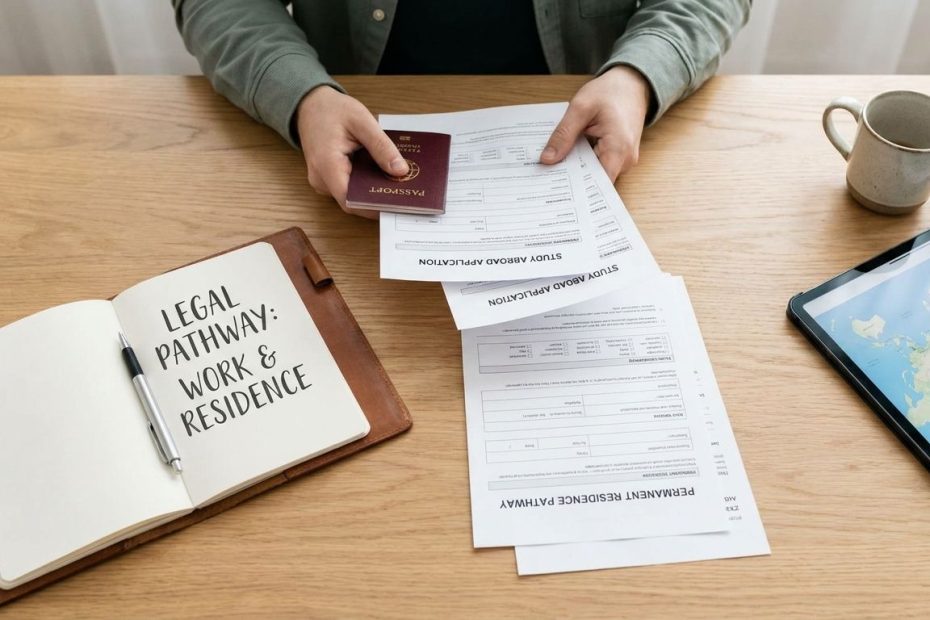
Studying abroad can lead to long-term residence, but it is never a guaranteed immigration shortcut. You need a qualifying program, legal post-study work rights, a realistic skilled-job plan, and a backup route before you submit your first application.
This guide gives you the decision points students often miss before choosing a country, university, and course. You will learn how major destinations compare, how visa officers assess intent, and how to build a study-to-work-to-residence plan that holds up under changing rules.
Can Studying Abroad Really Lead To Permanent Residency?
Yes, studying abroad can become a pathway to permanent residence when the destination country connects education, skilled work, and long-term immigration routes. The important point is sequence: a student visa lets you study, a post-study work route may let you work, and a skilled immigration route may later let you stay permanently.
You should treat your student visa as the entry point to a longer legal process, not as approval to settle. Most countries expect you to complete an eligible course, follow every student visa condition, gain relevant work experience, meet language or salary rules, and apply through a separate immigration category after graduation.
Canada shows this pattern clearly. International graduates may qualify for permanent residence categories managed through Express Entry, including the Canadian Experience Class, the Federal Skilled Worker Program, or a Provincial Nominee Program. Yet creating an Express Entry profile does not guarantee an invitation, and several routes depend on eligible Canadian work experience.
The United States works differently. The F-1 student visa is a temporary student category, and officers may ask for proof that you intend to depart after completing your study. A student can later move into Optional Practical Training, employer sponsorship, H-1B status, or another lawful route, but the student visa itself is not a direct green-card route.
The United Kingdom, Australia, Germany, and New Zealand all offer post-study work options, but those options usually give time rather than permanent status. Your real plan must extend beyond graduation: identify the job categories, salary levels, language standards, employer sponsorship rules, residence requirements, and application timing before you choose the course.
Which Country Is Easiest For Permanent Residence After Study Abroad?
There is no single easiest country for permanent residence after study abroad. The best destination depends on your occupation, academic level, language ability, work experience, budget, age, employer demand, and tolerance for policy changes.
Canada often appeals to students because the pathway from study to a Post-Graduation Work Permit to Canadian work experience is well known. That does not make it automatic. Canada has capped study permit issuance, tightened school and program rules, and added language and field-of-study checks for many post-graduation work permit applicants.
Germany can be strong for students who can use German in the labor market and target skilled employment. Graduates of German higher education institutions may receive a residence permit for up to 18 months to find skilled work, and German university graduates may apply for a settlement permit after working in Germany for more than two years.
Australia and New Zealand can work well when your qualification connects to skills demand. Australia’s Temporary Graduate visa has different streams for vocational and higher education graduates, and skilled migration later depends on occupation lists, points, regional options, nomination, or employer pathways. New Zealand’s Post Study Work Visa can lead to a resident visa, but lower-level qualifications may carry tighter job-related conditions.
The United Kingdom gives a useful Graduate visa, especially because it is unsponsored. The trade-off is that the Graduate route is not a settlement route, so you need to switch into Skilled Worker or another eligible category before long-term residence becomes realistic. The United States offers exceptional academic and labor-market opportunity, yet many graduates face uncertainty because employer sponsorship and H-1B selection remain competitive.
How Do Post-Study Work Visas Compare In The United States, Canada, United Kingdom, Australia, Germany, And New Zealand?
Post-study work permission is the bridge between your degree and your long-term immigration plan. It gives you time to gain work experience, prove labor-market value, and move toward a skilled visa or residence application.
The length of that bridge matters, but length alone is not enough. A three-year work window in a weak job market may be less useful than an 18-month window in a country where your occupation has strong demand and employers understand sponsorship.
- United States: F-1 students may use Optional Practical Training for temporary work related to their major. Eligible science, technology, engineering, and mathematics graduates may apply for a 24-month extension after post-completion Optional Practical Training.
- Canada: The Post-Graduation Work Permit allows eligible graduates from qualifying designated learning institutions to work after study. The work experience gained may support permanent residence applications through skilled immigration routes.
- United Kingdom: The Graduate visa lasts two years for most eligible applicants who apply on or before December 31, 2026, and 18 months for most eligible applicants who apply on or after January 1, 2027. Doctoral graduates can receive three years.
- Australia: The Temporary Graduate visa subclass 485 lets eligible graduates live, study, and work temporarily. The Post-Higher Education Work stream is usually two to three years, and the Post-Vocational Education Work stream can be up to 18 months.
- Germany: Graduates can apply for a residence permit for up to 18 months to seek skilled employment. After securing qualifying employment, they can move toward a residence permit for skilled workers or the European Union Blue Card.
- New Zealand: The Post Study Work Visa allows eligible graduates to stay and work for up to three years, depending on what they studied. Degree-level qualifications usually provide broader work rights than some lower-level programs.
The United States deserves special attention because demand is large and the path can be narrow. Open Doors data shows nearly 1.2 million international students in United States higher education, with 294,253 using Optional Practical Training. H-1B demand also remains substantial, with hundreds of thousands of eligible registrations in the most recent cap cycle.
Canada deserves equal caution for a different reason. The pathway is familiar, but recent intake controls and program-level rules mean you must verify eligibility before paying tuition. A school can be legitimate and still fail to give you the post-study work outcome you expected if the program itself does not qualify.
What Should You Check Before Choosing A University Or Course For Immigration?
Start with the immigration outcome, then work backward to the course. A respected university, a low tuition fee, or a fast admission letter does not automatically support your long-term plan.
Check whether the institution is approved for international students and whether the specific program qualifies for the post-study work route. In Canada, that means looking beyond the designated learning institution status and verifying program-level Post-Graduation Work Permit eligibility. In Australia, it means checking whether the course is registered and whether your qualification fits the right Temporary Graduate visa stream.
Check whether your field connects to skilled work. A course should lead to roles that appear in skilled occupation systems, sponsorship categories, shortage lists, or points-tested pathways. A degree that is interesting but weak in employer demand can limit your options after graduation.
Check language requirements early. Canada now requires many Post-Graduation Work Permit applicants to provide proof of English or French language ability, and Express Entry routes use Canadian Language Benchmark levels. Germany rewards students who can function in the workplace, and many employers will expect German ability even when the degree is taught in English.
Check timing. If you enter a one-year program, your post-study window may be shorter than a graduate from a longer program in some countries. If a route changes before you graduate, your backup plan becomes critical, especially in destinations where governments are reducing temporary migration or tightening student routes.
Check the true cost of reaching the next visa. Tuition is only one part of the calculation. You need living expenses, visa fees, health charges, document costs, language tests, credential assessments, legal advice when needed, and a financial buffer for the job search period after graduation.
Is It Risky To Tell A Visa Officer You Want To Immigrate After Studying?
It depends on the country and how you present your plan. Some governments openly recognize post-study pathways, but student visa applicants still need to prove that study is their genuine primary purpose and that they will follow visa conditions.
In the United States, the issue is sensitive because the F-1 visa is a nonimmigrant category. A consular officer may ask for evidence that you intend to depart after completing your course. Your answers should stay consistent with the temporary nature of the visa and the academic purpose of the trip.
In Australia, the Genuine Student requirement is more direct about future options. The government recognizes that genuine students may later develop skills Australia needs and may choose to apply for permanent residence. Future long-term interest does not count against an applicant under that rule, but the applicant must still show that studying is the primary reason for the visa.
Canada sits between those models. A study permit applicant must prove enough funds, admission to a designated learning institution, lawful conduct, health requirements when needed, and an ability to leave Canada when the permit expires. At the same time, Canada openly explains how international students may later apply through permanent residence categories.
Your safest position is honest, precise, and evidence-based. Do not present a low-value course as a disguise for migration. Show why the course fits your education and career plan, how you will finance it, why the country is suitable for the study goal, and how you will comply with the conditions attached to the visa.
How Can Students Improve Their Chances Of Staying After Graduation?
Your strongest plan starts before admission. You should select the country, course, school, and city based on the full route from study permit to post-study work to skilled employment to residence application.
Build your plan around the job you need after graduation. Identify job titles, salary ranges, licensing rules, language expectations, internship options, and employers that hire international graduates. If a job requires registration, certification, or local experience, start that process during your studies rather than after your final exam.
Use your study period to build employability, not just academic credits. Pursue internships, work placements, research assistant roles, part-time work allowed under your visa, industry projects, professional networking, and career-service support. Employers sponsor or hire graduates who reduce risk, communicate well, and show evidence of job-ready skills.
Prepare language tests early. Language scores can affect study permits, post-study work eligibility, points-based routes, provincial nomination, settlement pathways, and employer confidence. Waiting until graduation to sit a language test can cost you valuable months.
Track every immigration deadline. Post-study work applications often have strict filing windows and document requirements. Canada requires proof of study completion, full-time enrollment, language results when applicable, and field-of-study evidence for certain applicants. New Zealand requires eligible graduates to apply within a defined period after the student visa expires, depending on the qualification and visa history.
Create a backup route for each destination. A Canada plan may include Express Entry, a Provincial Nominee Program, or another work permit. A United States plan may include Optional Practical Training, science, technology, engineering, and mathematics Optional Practical Training, H-1B, cap-exempt employers, further study, or an employer-sponsored immigrant route. A United Kingdom plan may include the Graduate visa followed by Skilled Worker, and a Germany plan may include skilled worker residence or the European Union Blue Card.
What Are Students On Forums Most Worried About?
Students often worry about the same practical issues: whether permanent residence is guaranteed, which country is easiest, whether rules will change after enrollment, and whether employers will sponsor them after graduation. These worries are valid because study-abroad immigration routes are tied to labor markets and government policy.
A common concern is choosing a country based on old success stories. A friend who studied in Canada, Australia, or the United Kingdom several years ago may have benefited from rules that no longer apply. You need current rules for the intake year, graduation year, and expected post-study application period.
Another concern is course mismatch. Many students choose an affordable or easy-admission program without checking whether it leads to the right work permit, occupation category, or employer demand. That mistake can leave a graduate with a valid degree but limited legal pathways to stay.
Students also worry about employer sponsorship. This is especially strong in the United States and the United Kingdom, where the move from post-study work to long-term status often depends on a qualifying employer. You should research sponsorship patterns in your field before you accept admission.
Financial pressure comes up often as well. Students underestimate living costs, job-search time, visa fees, document expenses, and the cost of moving cities for work. An immigration plan needs a financial reserve, because deadlines do not wait for perfect conditions.
What Is The Smartest Study-To-Immigration Roadmap Before You Apply?
A smart roadmap starts with a target occupation, not a target campus. Choose the job category you want after graduation, then identify the countries where that category supports post-study work, employer sponsorship, points, nomination, or residence.
Map the route in order: student visa, study compliance, graduation documents, post-study work permit, skilled job, next visa, residence application. If any step is weak, fix it before paying a deposit. A missing link in the middle can break the entire plan.
Review each destination with five filters. The program must qualify for post-study work, the occupation must have demand, the post-study window must be long enough to secure work, the next visa must be realistic, and the residence route must fit your profile. If a country fails two or more filters, treat it as a poor immigration choice even if the university ranking looks attractive.
Use official sources as your primary reference. University agents, social media posts, and peer advice can help you collect questions, but official immigration pages determine eligibility. Rules change, and unofficial advice often lags behind policy updates.
Document every claim before you rely on it. Save screenshots or copies of course eligibility pages, visa requirements, language rules, field-of-study requirements, and deadlines. If a school, recruiter, or consultant says a program leads to post-study work, ask for the official page that proves it.
Can Study Abroad Lead To Permanent Residence?
- Yes, if your course, post-study work rights, and skilled job match residence rules.
- No student visa guarantees permanent residence.
- Plan the next visa before choosing a university.
Build The Route Before You Book The Flight
Study abroad can be a powerful immigration pathway when you treat it as a legal, academic, and labor-market plan from day one. Your best move is to choose a qualifying program, understand post-study work rules, target a skilled occupation, prepare language scores, and verify the next visa before you apply. Do not rely on country popularity, old student stories, or broad promises from recruiters. Build a plan that survives policy changes, job-market pressure, and document deadlines. If the route still looks strong after official-rule checks, you can apply with confidence and a clearer view of the work ahead.
Reference Links
- Immigration, Refugees and Citizenship Canada: International Students And Permanent Residence
- United States Department of State: Student Visa
- Government Of Canada: International Student Cap Allocations
- Make It In Germany: Visa For Studying And Staying After Graduation
- Study Australia: Temporary Graduate Visa Subclass 485
- GOV.UK: Graduate Visa
- GOV.UK: Immigration Rules Appendix Graduate
- Immigration New Zealand: Post Study Work Visa
- United States Citizenship And Immigration Services: Optional Practical Training Filing Information
- United States Citizenship And Immigration Services: H-1B Electronic Registration Process
- Government Of Canada: Post-Graduation Work Permit
- Government Of Canada: Post-Graduation Work Permit Documents
- Government Of Canada: Study Permit Eligibility
- Government Of Canada: Express Entry Eligibility
- Australian Department Of Home Affairs: Genuine Student Requirement
- Institute Of International Education Open Doors: International Students Data