
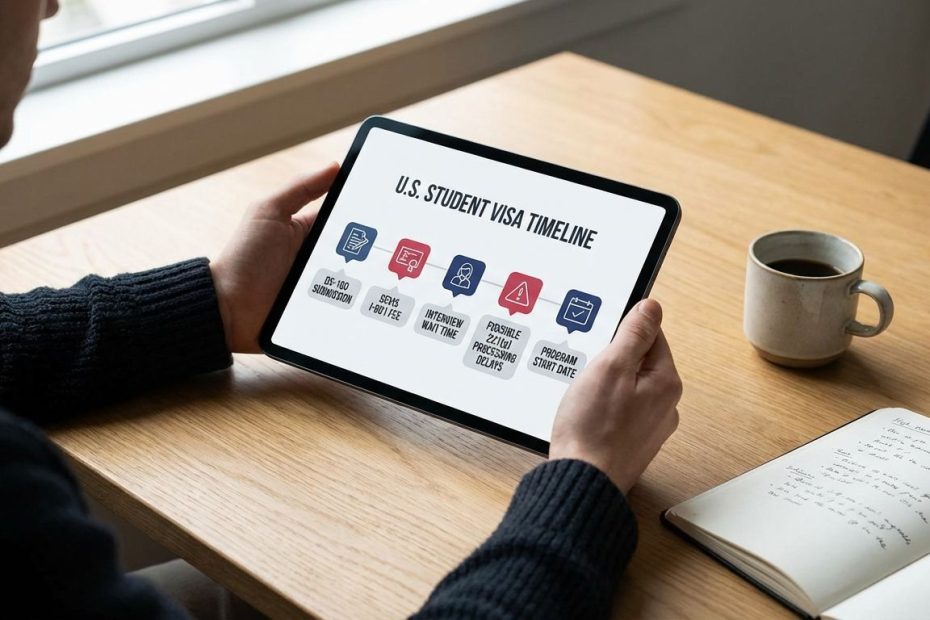
It usually takes a few weeks to a few months to get a U.S. student visa, and your actual timeline is driven less by “processing” and more by how fast you can secure a consular appointment and whether your case is selected for administrative processing (221(g)).
This guide breaks the timeline into the same checkpoints consular officers and school international offices watch: your I‑20 and SEVIS fee readiness, interview scheduling, post-interview issuance, and the delays that create real risk. You’ll also get planning rules that match the current “how early can you apply” guidance, plus a tight featured-snippet answer you can save for quick reference.
How Long Does It Actually Take To Get An F-1 Student Visa From Start To Finish?
From a practical operations viewpoint, an F‑1 timeline has three parts: preparation, waiting for the interview slot, and the post‑interview wrap-up. The preparation phase can move quickly when your school issues the I‑20 fast, your funding documents are clean, and you complete DS‑160 and fee steps without rework. Many applicants finish this phase in days, and strong planners keep it within one to two weeks by avoiding common errors like mismatched names, incorrect SEVIS IDs, or inconsistent travel history entries.
The second phase is the one that shifts your whole calendar: the consular appointment wait. The Department of State publishes an official wait-time tool, and the critical operational takeaway is that wait times can change as workload and staffing change and as new slots open. The numbers shown are estimates and should be treated like capacity signals, not guarantees, so planning needs buffers rather than a single “perfect” interview date.
The third phase starts when you walk out of the interview. If you are approved and no extra steps are required, the remaining time is largely printing and passport return logistics. If you are refused under 221(g) pending administrative processing or additional documents, the end-to-end timeline can expand substantially, with no fixed “standard” duration that applies to every applicant.
What Is The Biggest Bottleneck: Appointment Wait Time, Visa Printing, Or Administrative Processing?
Most of the time, the bottleneck is the interview calendar, not the visa sticker. Visa printing and passport return are usually the shorter leg of the journey, while appointment availability is the gate that can stretch from manageable to stressful depending on city and season. The wait-time tool is valuable because it forces an honest planning conversation early, before you commit to flights or housing deposits.
Administrative processing is the other bottleneck you must treat as a real possibility, even when the interview feels smooth. A case can be refused under 221(g) while additional review occurs, and the Department of State is explicit that the duration varies by the individual circumstances of each case. Operationally, this is why experienced advisors push for earlier interviews: you are buying time for the scenario you cannot fully control.
There is also a planning detail that trips people up: “processing time” is not the same as “appointment wait time,” and neither automatically includes delivery time for your passport. You should plan your timeline with separate buffers for getting an interview, any post-interview processing, and passport pickup or courier delivery windows.
How Soon Before Your Program Start Date Should You Apply, And What Is The Earliest You Can Get The Visa?
You can now be issued an F or M student visa up to 365 days before your program start date, which gives you a much longer runway than older rules allowed. That longer runway matters most when your local consulate is oversubscribed, since it lets you pursue earlier appointment slots without being blocked by the program start window. It also reduces the pressure to chase last-minute appointments that amplify mistakes in DS‑160 entries, fee payments, and document preparation.
Entry timing is a separate rule you must respect: you can generally enter the United States up to 30 days before the program start date listed on your Form I‑20. That means an early visa approval does not authorize early entry beyond that window, so planning should focus on getting the visa issued early while still timing travel appropriately. When this is managed correctly, you arrive with breathing room for housing, registration, and settling in without triggering an avoidable entry problem.
From a planning standpoint, the best move is to treat the process like a project plan with checkpoints. Once your I‑20 is issued, lock your DS‑160 and fee steps quickly, then pursue the earliest realistic interview date your post can support. When appointment inventory is tight, every week you delay at the start is a week you cannot recover later.
How Long Does The SEVIS Fee Step Take, And Can It Delay Your Interview?
The SEVIS I‑901 fee step is simple but time-sensitive, and it can create avoidable friction if you pay too late. ICE guidance instructs you to allow at least three business days for payment to be received and verified, and it also notes that posting to SEVIS and the Department of State consular system is typically within three working days. Consular officers rely on electronic verification, so the operational goal is to show up with a payment that is already visible in the system, not a payment that is still moving through posting cycles.
This is where disciplined sequencing matters. You can schedule an interview before the SEVIS fee record is posted, but you should avoid placing your interview inside that posting window. If your interview is too close to your payment date, you risk delays at the window, extra questioning, or being asked to return with updated proof that the system can confirm.
Execution standards that keep you safe are straightforward. Pay the SEVIS fee promptly after receiving the I‑20, print your confirmation, and store it with your interview packet. If you must pay close to the interview date, verify posting and carry printed proof so the conversation stays short and the officer can move on to eligibility rather than system visibility.
After Your F-1 Visa Interview, How Long Until You Get Your Passport Back?
If you are approved without follow-up steps, the remaining timeline usually depends on printing and local passport return logistics. The most important planning choice is to avoid commitments that require your passport immediately after the interview, since you will not control the exact day it is returned. Build buffer time for courier delivery or pickup scheduling, because local operational details vary by post.
If your case is placed in administrative processing, your passport return date can no longer be treated as predictable. The Department of State explains that some refusals under 221(g) require additional processing and that the duration varies by case. That variability is exactly why last-minute interviews are high-risk, even when your documents are strong.
When extra documents are requested, speed matters, accuracy matters more. Submit exactly what the consulate requests, in the requested format, and keep a clean record of what was submitted and when. Disorganized submissions create avoidable back-and-forth and can extend a timeline that is already uncertain.
Can You Skip The Interview With A Waiver Or Dropbox Option, And Does That Make It Faster In 2026?
You should plan on needing an interview unless your situation clearly matches a current waiver category and your specific post offers it for your visa class. The most recent State Department updates have narrowed interview waiver categories for many travelers, and the practical effect is that many applicants who assumed “dropbox” would apply will still need to book an in-person appointment. Your planning should begin with the assumption that an interview slot is required, then treat a waiver as an upside only after your post confirms eligibility and workflow.
Another planning factor is where you apply. The Department of State has stated that, effective September 6, 2025, nonimmigrant visa applicants should schedule interviews in their country of residence or nationality, and it also cautions that applying outside your country of residence can mean significantly longer waits. That guidance changes how many applicants should think about “shopping” for faster appointments, since the operational tradeoffs can increase delay and complexity rather than reduce it.
Even where a waiver is available, it does not automatically mean “fast.” You still have document intake, adjudication, and passport delivery steps, and any added review can extend the timeline. Planning should be built around verified post procedures, not assumptions based on another applicant’s experience in a different city.
What Causes The Biggest Delays, And What Is A Safe Timeline To Avoid Missing Your Start Date?
Delays are rarely mysterious. The most common drivers are simple: appointment scarcity, documentation issues that force rework, and post-interview administrative processing. Appointment scarcity spikes around major intake seasons, and the official wait-time table makes plain that wait times shift with workload and staffing and can change week to week.
A safe plan is built on buffers you can control. You control how fast you secure your I‑20, how cleanly you complete DS‑160, when you pay and verify the SEVIS fee, and how quickly you schedule the earliest viable appointment. You do not control whether additional review is required after the interview, so the only professional way to manage that risk is to interview early enough that a delay does not automatically force a program deferral.
Use a disciplined rule that aligns with how consular operations behave: target being interview-ready months ahead, not weeks ahead. If your program starts in late August, treat May or June as a sensible target window for the interview in many locations, then adjust based on your city’s published appointment waits and your school’s latest arrival expectations. This is not a legal requirement, it is capacity planning based on the reality that the calendar is the constraint.
How Long Does It Take To Get A U.S. Student Visa?
- Prep: days to 2 weeks
- Interview wait: varies by consulate
- After interview: days to weeks, longer if 221(g)
Lock Your Timeline Early, Then Protect It With Buffers
You get a reliable student-visa timeline by separating what you control from what you do not. Control the controllables by moving fast once you have the I‑20, paying SEVIS early enough for system verification, and booking the earliest realistic interview slot based on official wait-time data. Protect the uncontrollables by building buffer time for post-interview issuance and the possibility of administrative processing. Use the 365-day issuance window to your advantage, then align travel with the 30-day entry rule so arrival timing stays clean. If the goal is arriving on time without drama, the winning move is early execution paired with disciplined scheduling.
References
- U.S. Department of State, Visa Appointment Wait Times: https://travel.state.gov/content/travel/en/us-visas/visa-information-resources/wait-times.html.html
- U.S. Department of State, After the Interview (Administrative Processing, 221(g)): https://travel.state.gov/content/travel/en/us-visas/immigrate/the-immigrant-visa-process/step-10-prepare-for-the-interview/step-12-after-the-interview.html/
- Study in the States (DHS), New Student Visa Guidance (365 days, 30-day entry): https://studyinthestates.dhs.gov/2023/05/what-to-know-about-new-student-visa-guidance
- ICE (SEVP), I-901 SEVIS Fee FAQ (3 business days): https://www.ice.gov/sevis/i901/faq
- U.S. Department of State, Interview Waiver Update (Sept. 18, 2025): https://travel.state.gov/content/travel/en/News/visas-news/interview-waiver-update-sept-18-2025.html
- U.S. Department of State, U.S. Visas (Sept. 6, 2025 residency scheduling update): https://travel.state.gov/content/travel/en/us-visas.html